Introduction
Electrical contact pins are components where failure isn't an option—from automotive connectors and medical devices to circuit boards and farm equipment, a single faulty pin can compromise an entire system. In high-reliability applications, a defective contact can trigger costly recalls, safety incidents, or production downtime that ripples through supply chains.
US-based manufacturers offer distinct advantages: faster customization turnaround, supply chain reliability, and built-in compliance with domestic industry standards. The right manufacturing partner directly affects production quality, lead times, and total cost of ownership.
This guide profiles the top 10 electrical contact pins manufacturers in the United States, evaluated on manufacturing capability, technology, industries served, and product quality. Whether you're sourcing for high-volume automotive applications or precision medical connectors, use it to match your technical requirements to the right production partner.
Key Takeaways
- Electrical contact pins create reliable connections in automotive, medical, aerospace, and consumer electronics applications
- US manufacturers deliver supply chain stability, faster lead times, and easier compliance navigation than offshore alternatives
- Manufacturing method drives cost and quality: cold-forming, machining, and stamping each suit different volumes and geometries
- Leading US manufacturers include Electropin, Mill-Max, Amphenol, TE Connectivity, and Molex
- Match your application to the right method — high-volume precision, mission-critical complexity, or cost-sensitive standard runs each call for a different approach
What Are Electrical Contact Pins?
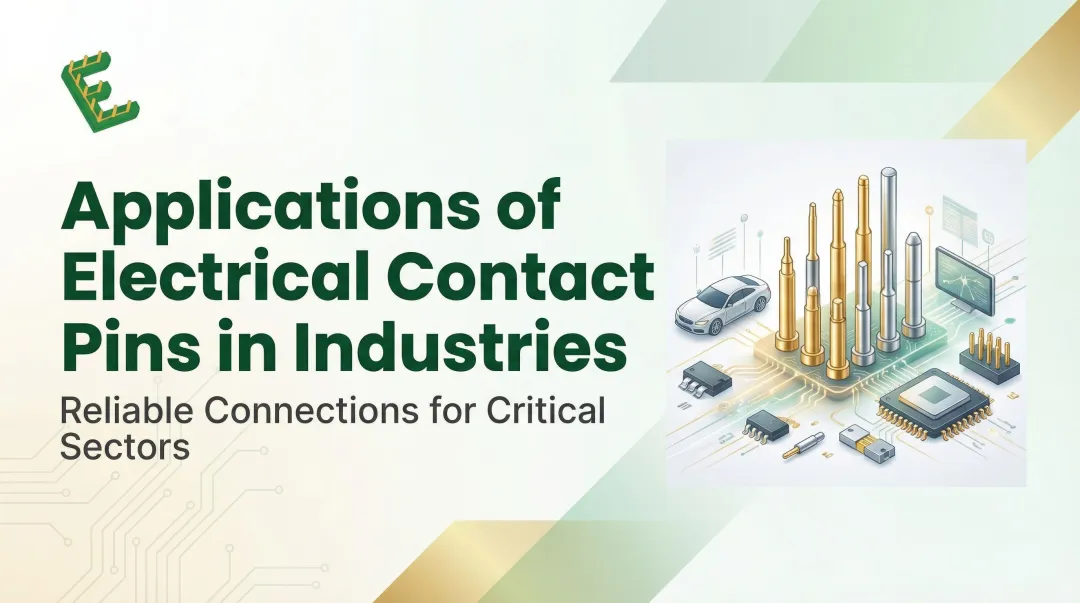
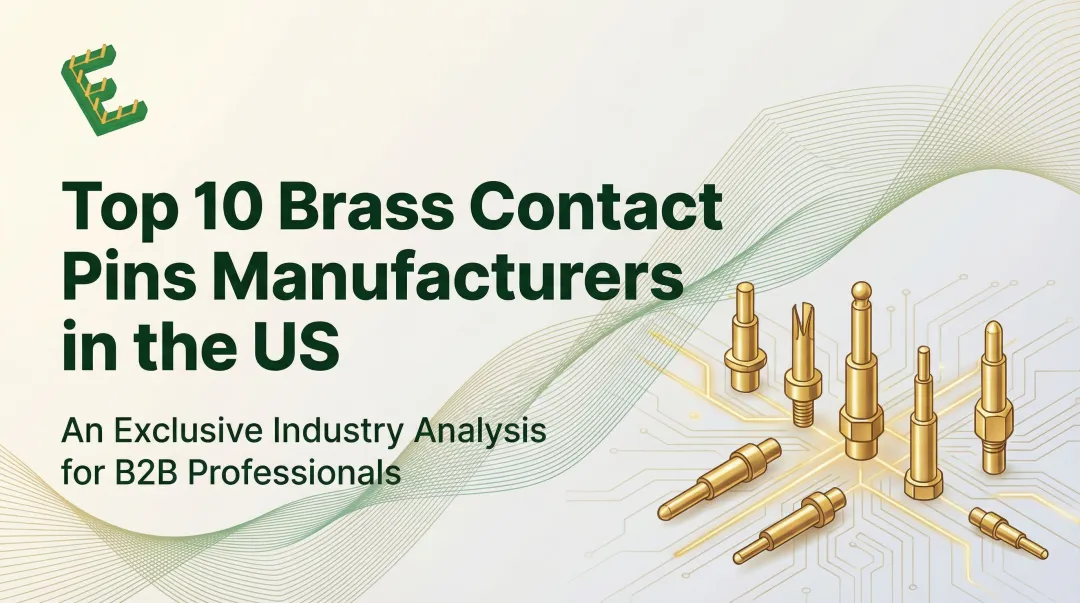
Electrical contact pins are small, precision-engineered metal components that create the physical interface for electrical current or signal transfer in connectors, circuit boards, and electromechanical assemblies. Geometry, material composition, and surface finish must all meet exact tolerances to ensure reliable performance across thousands—or millions—of mating cycles.
A poorly manufactured pin can introduce contact resistance, signal degradation, or intermittent failures that compromise entire systems.
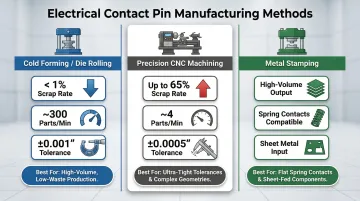
Three primary manufacturing methods dominate US production:
- Cold forming/die rolling: Wire is shaped under high pressure, displacing rather than removing material. Scrap rates stay below 1%, production reaches ~300 parts per minute, and tolerances hold to ±0.001" (±0.025mm).
- Precision CNC machining: Bar stock is cut on programmable lathes for complex geometries and tolerances as tight as ±0.0005" (±0.0125mm). The trade-off is steep: up to 65% scrap and roughly 4 parts per minute.
- Metal stamping: High-speed presses form spring contact geometries from sheet metal, suited to multi-finger clips and high-volume standardized contacts.
The global electrical connector market is projected to grow from $87.03 billion in 2025 to $168.5 billion by 2034, at a 7.2% CAGR. The specialized probe pin segment is expected to reach $1.08 billion by 2032. This growth reflects increasing demand for precision interconnects across automotive electrification, medical device innovation, and data center expansion—sectors where tight tolerances and consistent high-volume output determine which suppliers make the shortlist.
Top 10 Electrical Contact Pins Manufacturers in the US
These manufacturers were selected based on manufacturing technology sophistication, product quality benchmarks, industry breadth, US operational presence, and customer trust. The list spans custom specialists to large-catalog suppliers, representing the diversity of capabilities available to US buyers.
Electropin
Founded in 1943 as Autoswage Products, Inc., and rebranded as Electropin in 2019 after relocating to North Carolina, Electropin is a family-owned custom contact pins manufacturer now in its third generation. The company serves automotive, medical, farm equipment, computers, and circuit board industries with fully custom cold-formed pins designed to exact customer specifications.
Electropin's proprietary automatic die rolling technology sets it apart from competitors. Because no cutting occurs during manufacturing, there are no blunted parts or scrap material. Tools don't dull, so parts remain dimensionally consistent from unit 1 to unit 1,000,000. The process achieves a defect rate of 1 in 600,000,000 while producing up to five pins per second—all at lower cost than traditional machining. First batch delivery can occur in as little as two weeks when raw materials are available.
| Attribute | Details |
|---|---|
| Manufacturing Technology | Automatic die rolling (cold forming); no cutting, no scrap, no heat required |
| Industries Served | Automotive, medical connectors, farm equipment, computers, circuit boards, molded plastic parts |
| Key Differentiators | Zero-scrap production, RoHS/REACH compliant lead-free parts, first batch delivery in as little as two weeks, defect rate of 1 in 600,000,000 |
Mill-Max Manufacturing
Based in Oyster Bay, NY, Mill-Max operates a 150,000-square-foot vertically integrated facility specializing in precision-machined connector components. Founded in 1971, the company produces pins, receptacles, and spring-loaded pogo pins using proprietary high-speed CNC screw machine turning. Mill-Max maintains standard tolerances of ±.002" for diameters and ±.005" for lengths, making them a preferred supplier for applications requiring tight dimensional control.
Their receptacles feature a two-piece construction using machined shells (brass, phosphor bronze, or tellurium copper) paired with stamped beryllium copper inner contact clips. This hybrid approach balances precision with cost efficiency. Mill-Max serves aerospace, medical, defense, and PCB assembly markets where reliability is non-negotiable.
| Attribute | Details |
|---|---|
| Manufacturing Technology | CNC screw machine turning, high-speed precision machining |
| Industries Served | Aerospace, medical devices, defense electronics, PCB assembly |
| Key Differentiators | Vertically integrated US facility, ±.002" diameter tolerances, extensive catalog depth, ISO 9001 certified |
Amphenol Corporation
Headquartered in Wallingford, CT, since its 1932 founding, Amphenol is one of the world's largest connector manufacturers with significant US manufacturing operations. The company produces an extensive portfolio of electrical contacts and connector pins, with particular strength in military, aerospace, and high-speed data applications.
Amphenol's contacts are qualified to SAE AS39029 standards and include MIL-DTL-38999 Series I, II, and III systems for defense applications. For data communications, their ExaMAX and EXAMAX2 high-speed backplane contacts support up to 112 Gb/s PAM4 data rates using innovative beam-on-beam mating interfaces that minimize signal degradation. The company holds AS9100 and ISO 9001 certifications across multiple facilities.
| Attribute | Details |
|---|---|
| Manufacturing Technology | Stamped and machined contacts, high-speed backplane systems |
| Industries Served | Military, aerospace, automotive, data communications, telecommunications |
| Key Differentiators | Global scale with US production, AS9100/ISO 9001 certified, 112 Gb/s data rate capability, MIL-DTL-38999 qualified |
TE Connectivity
TE Connectivity operates multiple US manufacturing sites producing stamped and formed contacts supported by a comprehensive ecosystem of application tooling, including benchtop crimping machines and automated pin insertion equipment. The company's contact portfolio includes M8/M12 circular systems for industrial automation and DEUTSCH stamped contacts for commercial and industrial transportation.
TE's US facilities hold critical certifications including IATF 16949 for automotive, ISO 9001 for quality management, and AS9100 for aerospace applications. This certification depth makes TE a go-to supplier for buyers in heavily regulated industries requiring documented process control and traceability.
| Attribute | Details |
|---|---|
| Manufacturing Technology | Stamped/formed contacts, precision machining, automated assembly |
| Industries Served | Automotive, aerospace, industrial automation, defense, transportation |
| Key Differentiators | IATF 16949/AS9100/ISO 9001 certified, M8/M12 circular connector systems, extensive tooling ecosystem, global reach with domestic production |
Molex
Established in 1938 and headquartered in Lisle, IL, Molex leverages vertically integrated manufacturing encompassing stamping, injection molding, and plating. Their contact pin capabilities range from Micro-Fit micro-miniature contacts to Sentrality high-current pin and socket interconnects. The Sentrality line offers surface-mount (SMT), press-fit, and screw-mount pin options, featuring OmniGlide technology that allows sockets to float and self-align during mating.
Molex serves consumer electronics, automotive telematics, and medical device markets with a focus on miniaturization and high-density interconnect solutions. Their vertically integrated US operations enable tight control over quality and intellectual property protection.
| Attribute | Details |
|---|---|
| Manufacturing Technology | Stamped and plated contacts, vertically integrated stamping/molding/plating |
| Industries Served | Consumer electronics, automotive telematics, medical devices, industrial automation |
| Key Differentiators | Micro-miniature contact capability, SMT-compatible pin options, vertically integrated manufacturing, ISO 9001 certified |
Smiths Interconnect
Smiths Interconnect provides high-reliability spring probes and hyperboloid contacts (KA Series) compliant with MIL-DTL-55302 standards for defense and aerospace applications. Following the acquisition of Plastronics (headquartered in Irving, TX), Smiths expanded its semiconductor test portfolio with patented H-Pin technology.
The H-Pin replaces traditional machined pogo pin barrels with two beryllium copper stampings and a stainless steel spring, enabling fully automated reel-to-reel assembly. H-Pins deliver up to 15 GHz bandwidth, carry up to 4A of current, withstand temperatures over 200°C, and achieve mechanical life ratings up to 1,000,000 cycles. All of this comes at a fraction of the cost of screw-machined alternatives.
| Attribute | Details |
|---|---|
| Manufacturing Technology | Precision-machined spring contact pins, stamped spring probes (H-Pin) |
| Industries Served | Defense, aerospace, semiconductor test, medical devices, space applications |
| Key Differentiators | MIL-DTL-55302 compliance, 15 GHz bandwidth H-Pin technology, 1,000,000-cycle life rating, AS9100 certified |
Plastronics
Based in Allen, TX and now operating under Smiths Interconnect, Plastronics brings a specialized focus to high-density test socket interconnects for semiconductor test and burn-in applications. Where Smiths covers the broader defense and aerospace spring probe portfolio, Plastronics concentrates specifically on the ATE (automated test equipment) market — supplying semiconductor manufacturers and electronics validation labs with socket solutions optimized for high pin density and extended cycle life.
Their test sockets are designed around the H-Pin platform (detailed under Smiths Interconnect above) and are particularly valued in burn-in environments where sustained signal integrity at GHz frequencies and multi-million cycle repeatability are both required.
| Attribute | Details |
|---|---|
| Manufacturing Technology | Proprietary H-Pin stamped spring contact technology |
| Industries Served | Semiconductor test, electronics manufacturing, burn-in testing, ATE systems |
| Key Differentiators | High pin density test socket specialization, sustained GHz-level signal integrity, multi-million cycle burn-in capability, Smiths Interconnect backing |
QA Technology
Founded in 1981 and based in Hampton, NH, QA Technology specializes in spring-loaded test probes and hyperboloid contacts for PCB and semiconductor testing. Their ISO 9001:2015 certified US facility produces the socketless X Probe series and conventional ICT/FCT probes designed for long test cycle repeatability.
QA Technology offers probes with music wire springs (rated to 120°C) and stainless steel springs (rated to 204°C) to maximize cycle life in extreme testing environments. The company provides detailed cycle life guarantees and test documentation, making them a preferred supplier for validation engineers requiring documented performance.
| Attribute | Details |
|---|---|
| Manufacturing Technology | Spring-loaded probe pin manufacturing, hyperboloid contact systems |
| Industries Served | PCB test, semiconductor validation, electronics manufacturing, ATE systems |
| Key Differentiators | Cycle life guarantees, 204°C high-temperature capability, ISO 9001:2015 certified, US manufacturing commitment |
Keystone Electronics
Operating out of Astoria, NY, Keystone Electronics is a major US manufacturer of PCB hardware including contact pins, terminals, and interconnects. The company offers extensive off-the-shelf catalog availability through major distributors like Digi-Key and Mouser, making them a go-to source for engineers needing quick-turn access to standard pin formats.
Their contact pin portfolio includes micro pins ranging from .017" to .080" in diameter, available in press-fit, swage mount, and solder mount formats. They also manufacture ultra-low profile SMT test points and pins supplied on tape and reel for automated PCB assembly.
| Attribute | Details |
|---|---|
| Manufacturing Technology | Stamped and formed PCB hardware, automated tape-and-reel packaging |
| Industries Served | PCB assembly, industrial electronics, consumer electronics, prototyping |
| Key Differentiators | Extensive catalog depth, off-the-shelf availability through major distributors, SMT tape-and-reel options, ISO 9001:2015 certified |
NorComp
Headquartered in Charlotte, NC, NorComp focuses on ruggedized I/O connectors and contact pin systems with emphasis on environmental protection. Their SEAL-D series utilizes proprietary internal sealing technology to achieve IP67 and IP68 ratings while maintaining the exact same physical footprint as standard unsealed D-Sub connectors.
This allows engineers in industrial, medical, and marine electronics sectors to upgrade to waterproof contacts without redesigning enclosures or PCBs. The SEAL-D technology enables standard contact pins to withstand 1-meter submersion for 30 minutes without requiring bulky external overmolds.
| Attribute | Details |
|---|---|
| Manufacturing Technology | Stamped contacts with overmolded or internally sealed housings |
| Industries Served | Industrial automation, medical electronics, military electronics, marine systems |
| Key Differentiators | IP67/IP68-rated internal sealing (SEAL-D series), standard footprint compatibility, RoHS/REACH compliant |
How We Chose the Best Electrical Contact Pins Manufacturers
Selection criteria focused on five key factors: manufacturing technology and process control (consistency from unit 1 to volume production), industry coverage and application range, quality standards (defect rates, RoHS/REACH compliance, and industry-specific certifications), customization capability (ability to produce non-catalog designs within reasonable lead times), and US operational presence for supply chain reliability and IP protection.
Common sourcing mistakes to avoid:
- Choosing suppliers based solely on catalog availability without verifying tolerance consistency at volume
- Prioritizing upfront unit cost without accounting for scrap rates, rework, and defect-driven downtime costs
- Ignoring manufacturing method implications for long-term quality and scalability
Manufacturing method has a direct impact on quality, cost, and scalability. Here's how the three primary methods compare:
| Method | Best For | Key Tradeoff |
|---|---|---|
| Machined | Complex profiles, low volume | Tool wear causes dimensional drift at scale; high scrap |
| Stamped | Flat, simple geometries | Efficient at high volume but limited to standardized designs |
| Cold-formed (die-rolled) | High-volume precision runs | Zero material waste, consistent parts — but tooling investment requires volume commitment |
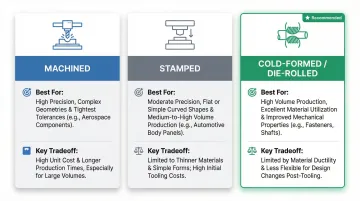
At high volumes, cold-forming can achieve defect rates below 50 PPM, meeting automotive Six Sigma expectations. Machining, by contrast, requires frequent tool replacement and in-process inspection to hold tolerances, raising overall costs despite lower piece prices.
Conclusion
Choosing an electrical contact pins manufacturer is a technical decision that directly affects your product's reliability, compliance posture, and total cost of production. Before committing to a supplier, evaluate each candidate on:
- Manufacturing method and its effect on part consistency
- Defect rate transparency and quality documentation
- Scalability from prototype through volume production
- Lead time on custom work and tooling changes
- Material compliance with REACH, RoHS, and application-specific standards
Domestic US manufacturers reduce supply chain risk while providing more accessible engineering support, faster design iteration, and cleaner navigation of regulatory requirements for automotive, medical, and defense applications.
For buyers who need custom contact pins at high quality, zero scrap, and fast turnaround, Electropin's automatic die rolling technology — backed by over 80 years of manufacturing experience — is worth a direct conversation. Call +1 919-288-1203 to discuss your application requirements and what cold-forming can do for your production costs.
Frequently Asked Questions
What are electrical contact pins used for?
Electrical contact pins establish physical electrical connections in connectors, PCBs, and electromechanical assemblies across automotive, medical, aerospace, consumer electronics, and industrial equipment. They enable reliable current transfer and signal transmission in applications ranging from vehicle wiring harnesses to medical device connectors.
What is the difference between machined and cold-formed electrical contact pins?
Machined pins are cut from bar stock on CNC lathes, offering flexibility for complex shapes but generating up to 65% scrap and consistency issues at volume due to tool wear. Cold-formed/die-rolled pins are shaped without cutting, producing zero scrap, no tool degradation, and highly consistent parts at scale with production rates up to 75 times faster than machining.
How do I choose the right electrical contact pins manufacturer in the US?
Evaluate manufacturing process, certifications (RoHS, REACH, IATF 16949, ISO 9001, AS9100), customization capability, lead times, and scalability from prototype to full production. Manufacturing method should match volume: cold-forming for high-volume precision, machining for low-volume complex geometries, stamping for standardized high-volume designs.
What materials are typically used in electrical contact pins?
Common base materials include brass, phosphor bronze, and beryllium copper, chosen for conductivity, spring properties, and formability. Surface finishes — gold (corrosion protection), tin (solderable, cost-effective), and nickel (wear resistance) — are selected based on conductivity requirements, contact life, and RoHS/REACH compliance.
What industries use electrical contact pins most heavily?
Automotive, medical devices, consumer electronics, aerospace/defense, industrial automation, and farm equipment represent the largest application sectors, each with distinct requirements around reliability, environmental performance, and regulatory compliance.
What defect rate should I expect from a quality contact pins manufacturer?
World-class automotive suppliers maintain defect rates below 50 PPM (parts per million), while critical medical device manufacturing demands below 10 PPM. Advanced cold-forming processes can achieve extremely low defect rates—Electropin's automatic die rolling achieves 1 defect per 600,000,000 pins. Machining and stamping typically see higher variability at volume due to tool wear, requiring frequent inspection and process adjustment.