Introduction
Pick the wrong hollow pin supplier and you'll feel it fast: missed tolerances, delayed shipments, or compliance problems that hold up your entire production line. For OEMs in automotive, medical, farm equipment, and circuit board manufacturing, the stakes are too high to leave sourcing to chance.
US-based manufacturers offer something offshore alternatives can't — shorter lead times, tighter supply chain control, easier regulatory compliance, and direct engineering support when your specs need refining.
This article covers the top 10 hollow pin manufacturers in the US, what sets each one apart, and what to look for when evaluating them against your application requirements.
Key Takeaways
- Hollow pins are tubular precision fasteners and contact components used across industrial, electrical, and mechanical assemblies
- US-based manufacturers offer shorter lead times, tighter custom tolerances, and closer engineering collaboration than offshore suppliers
- Manufacturers vary by method (die rolling, cold heading, machining), material range, and production scale
- Evaluate suppliers on tolerances, certifications, defect rates, and minimum order requirements before committing
- Electropin stands out for its proprietary automatic die rolling technology, near-zero defect rate, and fast custom turnaround
What Are Hollow Pins and Where Are They Used in US Industry
Hollow pins are cylindrical tubular components—distinct from solid dowel or spring pins—used to transfer electrical signals (contact pins), align assemblies, or serve as lightweight fastening elements. The term "hollow pin" spans both structural hollow fasteners and hollow contact/connector pins, each serving different but equally critical functions.
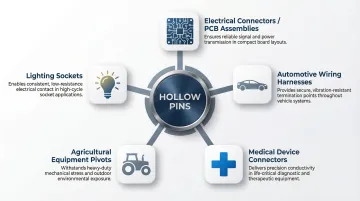
Primary industrial applications include:
- Electrical connector systems and PCB assemblies
- Automotive wiring harnesses
- Medical device connectors
- Agricultural equipment pivots
- Fluorescent and LED lighting sockets
In these applications, dimensional accuracy and material consistency are critical. A contact pin that's out of spec by 0.05mm can cause connection failures in a medical device, while a spring pin with inconsistent radial tension can damage host materials during press-fit insertion.
The manufacturers below span cold forming, die rolling, and precision machining — selected for their demonstrated capability in the tolerances and volumes these industries require.
Top 10 Hollow Pin Manufacturers in the US
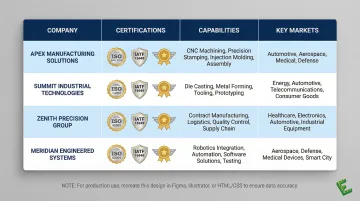
Each manufacturer below was selected on manufacturing capability, industry reputation, product range, certifications, and capacity for both custom and high-volume orders.
Electropin (Autoswage Products, Inc.)
Founded in 1943 in Connecticut as Autoswage Products, Inc., and rebranded as Electropin after relocating to North Carolina in 2019, this company specializes in custom hollow contact pins for automotive, medical, electronics, farm equipment, and circuit board applications using a proprietary automatic die rolling process.
Key differentiators:
- Automatic die rolling eliminates scrap (no cutting, no heat)
- Tools never dull, ensuring consistency from part 1 to part 1,000,000+
- Defect rate of 1 in 600,000,000
- Production speed of up to 5 pins per second
- Lead-free REACH/RoHS-compliant output
- Custom orders deliverable in as little as two weeks
| Manufacturing Method | Automatic die rolling (proprietary)—no machining, no scrap, no blunted parts |
|---|---|
| Key Differentiator | Defect rate of 1 in 600,000,000; up to 5 pins/second; fully scalable production |
| Industries Served | Automotive, medical connectors, farm equipment, computers, circuit boards, molded plastic parts |
SPIROL International Corporation
Headquartered in Danielson, Connecticut, and founded in 1948, SPIROL is the original inventor of the Coiled Spring Pin. Operating as a direct manufacturer with global facilities, they produce Standard, Heavy, and Light Duty Coiled Spring Pins, Slotted Spring Pins, and Ground Hollow Dowels.
Key differentiators:
- Extensive engineering support resources and complimentary Application Engineering
- Comprehensive material variety across carbon steel, stainless steel, and specialty alloys
- Multiple certifications: IATF 16949, ISO 9001, AS9100, ISO 14001, and Nadcap
- Ground Hollow Dowels maintain critical alignment within 20 µm while reducing weight by over 50% compared to solid dowels
| Manufacturing Method | Coiling and roll-forming processes for spring/hollow pin production |
|---|---|
| Key Differentiator | Original coiled spring pin inventor; extensive DFM services and technical documentation |
| Industries Served | Automotive, aerospace, medical devices, agricultural equipment, industrial machinery |
Bead Electronics
Headquartered in Milford, Connecticut, Bead Electronics (a division of Bead Industries, founded in 1914) specializes in custom hollow contact pins and tubular connector pins for electrical and electronic applications. They operate as a direct manufacturer using a proprietary "scrapless swaging" cold-forming process.
Key differentiators:
- Scrapless swaging achieves 30-70% material savings compared to traditional machining
- IATF 16949:2016 and ISO 9001:2015 certified
- Extensive customization including base metals (brass, phosphor bronze, copper alloys, stainless steel) and platings (tin, nickel, gold, palladium, silver)
- Focus on high-volume production for telecom, automotive, PCB, and medical industries
| Manufacturing Method | Proprietary scrapless swaging (cold-forming) for hollow contact pins |
|---|---|
| Key Differentiator | 30-70% material savings; extensive plating and finish options |
| Industries Served | Telecommunications, automotive, PCB assembly, medical devices |
G.L. Huyett
Located in Minneapolis, Kansas, and founded in 1899, G.L. Huyett operates as both a master distributor and manufacturer of industrial fasteners. They stock an extensive range of hollow pins including coiled spring pins, slotted spring pins, and ground hollow dowel pins that comply with ASME B18.8.2, ASME B18.8.3M, ISO 8748, and ISO 8750 standards.
Key differentiators:
- Deep stocking depth for immediate MRO fulfillment
- ISO 9001:2015 certified
- Serves fastener distributors supplying both OEMs and MRO markets
- Standards-compliant catalog with explicit ASME and ISO specifications
| Manufacturing Method | Hybrid model: coiling/roll-forming for manufactured pins; master distribution for stocked products |
|---|---|
| Key Differentiator | Extensive catalog breadth; immediate availability for standard sizes |
| Industries Served | OEM and MRO markets across automotive, construction, industrial machinery |
Spex Precision Machine Technologies
Headquartered in Rochester, New York, Spex is an ISO 9001:2015 certified custom contract manufacturer specializing in Swiss screw machining and CNC turning. They produce custom precision pins, including hollow/coiled cylinders (spring pins), for industrial and OEM applications.
Key differentiators:
- Swiss screw machining achieves extreme dimensional tolerances of ±0.005mm (0.0002 inches)
- ISO 9001:2015 certified (Registration Number: 022495)
- Multi-material expertise across brass, stainless steel, aluminum, and specialty alloys
- Ideal for low-volume or highly complex geometries requiring micro-tolerances
| Manufacturing Method | Swiss screw machining and CNC precision machining for custom hollow pin geometries |
|---|---|
| Key Differentiator | Tolerances as tight as ±0.005mm; ISO 9001:2015 certified; custom geometry capability |
| Industries Served | Power/electrical, measurement/instrumentation, HVAC, chemical processing, agricultural equipment |
Fascomp
Founded in 2001 with headquarters in Orlando, Florida, Fascomp is a hybrid manufacturer and distributor of electronic hardware. They manufacture hollow standoffs (Hex and Round Male-Female) and spacers primarily for electronics, telecommunications, medical, and aerospace markets, including Boeing.
Key differentiators:
- Dual-footprint model: 70% manufactured in Shenzhen, China; 30% (specialty products) in Naugatuck, Connecticut
- ISO 9001:2015 certified
- Quick-turn production with $15 minimum order
- Offshore production for standard pricing; domestic Connecticut facility for aerospace-certified components
| Manufacturing Method | Machining or cold forming for hollow electronic pins (dual-location production) |
|---|---|
| Key Differentiator | Quick-turn capability; low minimum order; hybrid domestic/offshore model |
| Industries Served | Electronics, PCB assembly, telecommunications, medical, aerospace (Boeing) |
Precision Brand Products
Headquartered in Downers Grove, Illinois, and founded in 1946, Precision Brand Products operates as a packager and distributor for toolroom and maintenance applications. They supply Roll Pin (slotted spring pin) assortments in both imperial and metric sizes, manufactured from spring steel and stainless steel.
Key differentiators:
- ASME B18.8.2 standards compliance
- ISO 9001 certified facility
- Extensive assortment packaging for MRO applications
- Focus on toolroom and maintenance markets
| Manufacturing Method | Distribution and packaging of roll-formed slotted spring pins |
|---|---|
| Key Differentiator | Standards compliance portfolio; catalog depth; MRO-focused assortments |
| Industries Served | MRO markets, toolroom applications, industrial maintenance |
Rotor Clip Company
Based in Somerset, New Jersey, Rotor Clip is an established manufacturer of retaining rings, wave springs, and hose clamps, with additional production of slotted and coiled spring pins as part of their fastening component portfolio. The company holds IATF 16949, AS9100, and ISO 9001 certifications.
Key differentiators:
- Multiple quality certifications including IATF 16949 and AS9100
- Global manufacturing footprint
- In-house tooling and stamping capability supporting high-volume spring pin orders
- Spring pin materials include carbon steel, stainless steel, and beryllium copper for specialized applications
| Manufacturing Method | Stamping and forming processes for spring-type fasteners |
|---|---|
| Key Differentiator | Multiple certifications (IATF 16949, AS9100); global reach |
| Industries Served | Automotive, electronics, industrial machinery, aerospace |
American Precision Industries (API)
Based in Hillsboro, Oregon, API is an AS9100 and ISO 9001 certified custom CNC machine shop. While they offer precision machining capabilities, their specific hollow pin product lines focus on custom-manufactured tubular components for aerospace and defense applications.
Key differentiators:
- AS9100, ISO 9001, and ITAR certified
- Precision CNC machining for complex geometries
- Multi-material expertise across aluminum, stainless steel, titanium, and specialty alloys
- Focus on aerospace and defense sectors with strict quality requirements
| Manufacturing Method | CNC machining and Swiss screw machining for custom precision pins |
|---|---|
| Key Differentiator | AS9100 certified; ITAR registered; aerospace/defense focus |
| Industries Served | Aerospace, defense, medical, automotive |
Pivot Point Inc.
Based in Hustisford, Wisconsin, Pivot Point manufactures non-threaded fasteners including clevis pins and SLIC pins for heavy equipment and agricultural applications. While their primary focus is solid structural pins, they also produce hollow locking pin assemblies for specific applications.
Key differentiators:
- ISO 9001 certified
- Quick-release and locking hollow pin designs
- Material options including stainless steel and alloy steel
- Focus on heavy equipment and agricultural sectors
| Manufacturing Method | Cold forming, machining, or stamping for hollow locking pin assemblies |
|---|---|
| Key Differentiator | Quick-release hollow pin systems; custom engineering for heavy equipment |
| Industries Served | Agriculture, construction, off-highway equipment |
How to Choose the Right Hollow Pin Manufacturer
The most common mistake buyers make is prioritizing unit price over total cost of quality. A low per-pin cost with a high defect rate or inconsistent tolerances will cost far more in rework, line downtime, and warranty claims than paying slightly more for a reliable manufacturer.
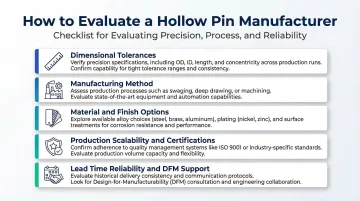
Key evaluation factors:
Dimensional Tolerance Capabilities
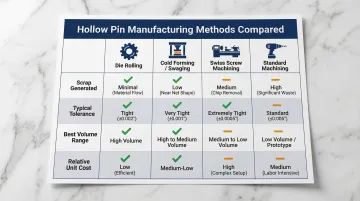
Tolerance requirements vary significantly by application. Precision hollow pins can reach tolerances as tight as ±0.005mm via Swiss screw machining or die rolling. Standard cold-headed hollow pins typically hold ±0.05mm. For heavy-duty spring pins, ISO 8748 requires the mating hole diameter to match the nominal pin diameter at tolerance class H12.
Manufacturing Method
Die rolling vs. cold heading vs. machining affects consistency and scrap:
- Die rolling: Zero scrap, tools never dull, consistent quality across millions of parts
- Cold forming/swaging: 30-70% material savings compared to machining, ideal for high-volume contact pins
- Swiss screw machining: Achieves tightest tolerances (±0.005mm) but higher setup costs; most cost-competitive for 1,000-200,000+ pieces
- Standard machining: Lower initial cost but generates scrap and suffers from progressive tool wear
Material and Finish Options
Material selection dictates both cost and environmental resistance:
- Brass and copper alloys: Preferred for electrical contact pins (conductivity)
- Stainless steel (300/400 series): Corrosion resistance for medical or fluid-handling uses
- Carbon or alloy steel: High-load mechanical applications
- REACH/RoHS compliance: Essential for EU markets; lead-free materials eliminate regulatory concerns
Production Scalability
Can the supplier ramp from prototype to millions without quality drift? Implementing IATF 16949 can reduce the cost of poor quality by up to 40% through defect prevention and variation reduction.
Lead Time Reliability
The US industrial fasteners market is projected to reach $23.18 billion by 2033, with the non-threaded segment (pins, washers, rivets) growing at 3.7% CAGR. Demand is increasing, making lead time reliability critical.
Certifications and Traceability
Use certifications as a baseline filter:
- ISO 9001: Minimum quality management standard
- IATF 16949: Required for automotive wiring harnesses
- AS9100: Essential for aerospace connector pins
- FDA-relevant standards: Critical for medical device applications
Beyond certifications, ask whether the supplier offers design-for-manufacturability (DFM) review before tooling. Catching geometry or material issues at the design stage costs nothing — catching them after tooling can cost thousands.
Conclusion
The right hollow pin supplier depends on your tolerance requirements, material needs, volume flexibility, and compliance obligations—not just brand recognition or catalog size. Request samples, ask about defect rates, and evaluate a supplier's willingness to collaborate on design refinement before committing to a production run.
For teams sourcing custom hollow contact pins with near-zero defect requirements and fast turnaround, Electropin's automatic die rolling technology—with a defect rate of 1 in 600,000,000 and delivery in as little as two weeks—is worth a conversation. Contact Electropin at +1 919-288-1203 to discuss your requirements.
Frequently Asked Questions
What are hollow pins used for in industrial applications?
Hollow pins serve as contact pins in electrical connectors, alignment components in assemblies, and lightweight fastening elements in machinery. Applications range from PCB connector pins and automotive wiring harnesses to agricultural pivot pins and medical device trigger mechanisms.
What is the best metal for hollow pins?
The best metal depends on the application: brass and copper alloys are preferred for electrical contact pins due to conductivity, stainless steel for corrosion resistance in medical or fluid-handling uses, and carbon or alloy steel for high-load mechanical applications.
How much does it cost to get a custom hollow pin made?
Pricing depends on material, manufacturing method, tolerances, and volume. Standard slotted spring pins can run as low as $0.03 per unit at high volumes, while custom Swiss-machined pins with tight tolerances typically range from $0.50 to several dollars per unit.
Can you manufacture hollow pins in the US?
Yes, numerous US-based manufacturers produce hollow pins domestically. They offer advantages in lead time (as little as two weeks for custom orders), supply chain reliability, engineering support, and compliance with standards like IATF 16949 and AS9100.
What is the difference between a hollow pin and a spring pin?
Spring pins are a subset of hollow pins designed to compress during insertion for a snug fit in the host material. Hollow pins is a broader term covering any tubular pin—contact pins, tubular dowels, pivot pins—that may lack spring or radial compression functionality.
What tolerances can hollow pins be manufactured to?
Precision hollow pins can be manufactured to very tight tolerances depending on the method: die rolling and Swiss screw machining can achieve tolerances as tight as ±0.005mm (0.0002 inches), while standard cold-headed hollow pins typically hold tolerances in the ±0.05mm range. ASME B18.8.2 and ISO 8748 standards govern dimensional specifications for spring pins.