Introduction
A single faulty compliant pin can cascade into catastrophic failure. A poorly seated pin in an automotive control module can trigger safety system malfunctions. In medical diagnostic equipment, intermittent connections compromise patient data integrity. In aerospace backplane assemblies, vibration-induced failures can ground entire fleets.
The financial stakes are just as severe: a $45 connector failure can generate nearly $12,000 in equipment downtime, and connector defects account for up to 58% of annual revenue loss in commercial solar portfolios.
US-based compliant pin manufacturers offer faster lead times, direct alignment with IATF 16949 and AS9100 standards, and supply chain transparency that multi-tier offshore sourcing can't provide. For production lines that depend on zero-defect press-fit connections, domestic sourcing reduces both compliance risk and response time when specifications change.
This guide cuts through the noise. Each manufacturer below was evaluated on manufacturing technology, documented defect rates, industry certifications, and scalability across automotive, medical, aerospace, and industrial applications.
Key Takeaways
- Compliant pins create permanent, solderless PCB connections through elastic interference fit—a method IEC standards recognize as significantly more reliable than soldering
- The US press-fit connector market is accelerating at 6.4% CAGR, driven by EV/ADAS adoption and RoHS compliance mandates
- Manufacturing method determines application fit — precision stamping suits high-volume automotive runs, while Swiss CNC machining handles custom aerospace geometries
- Top-tier manufacturers achieve defect rates as low as 1 per 600,000,000 pins — Electropin's die rolling process is one example of what zero-scrap production looks like in practice
- Evaluate suppliers on defect rates, insertion force monitoring, and material traceability—not unit price alone
What Are Compliant Pins and Why Do They Matter?
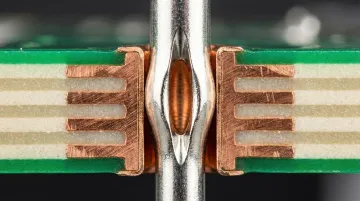
Compliant pins are precision-engineered interconnects designed to be press-fit into plated through-holes (PTHs) on printed circuit boards without soldering. Unlike standard through-hole pins that require wave soldering or spring-loaded pogo pins designed for temporary contact, compliant pins rely on controlled elastic deformation to maintain a permanent, gas-tight electrical connection through mechanical interference.
The pin's specially shaped "press-in zone" undergoes elastic deformation upon insertion, conforming to the PTH and sustaining continuous normal force that generates a cold-welded intermetallic bond. The result:
- Eliminates thermal stress on the PCB during assembly
- Avoids soldering defects like bridges and flux residuals
- Delivers connections at least 10× more reliable than soldering, per IEC 1709
Market Growth Drivers:
The global press-fit connector market reached $9.8 billion in 2024 and is projected to grow at 6.4% CAGR to $14.2 billion by 2030. This acceleration is fueled by automotive electrification, advanced driver-assistance systems (ADAS), and RoHS-compliant green manufacturing that eliminates lead-based solders. High-vibration environments—engine control units, ABS/ESC systems, industrial automation—favor press-fit over solder joints prone to thermal fatigue and fracture.

Sourcing from a qualified US manufacturer reduces regulatory risk, shortens supply chains, and provides direct access to engineering support for design-for-manufacturability optimization. Each manufacturer listed below was evaluated on production capability, certifications, industry specialization, and engineering depth.
Top 10 Compliant Pins Manufacturers in the US
These manufacturers were selected based on manufacturing precision, industry certifications, production capacity, documented quality metrics, and proven track records across automotive, medical, aerospace, and industrial sectors.
Electropin
Electropin (legally Autoswage Products, Inc.) is a North Carolina-based family business with over 80 years of manufacturing heritage. Founded in 1943 by Bartley E. Hall in Connecticut to produce fluorescent lightbulb pins using cold-forming techniques, the company evolved into a premier custom contact pin manufacturer serving automotive, medical, farm equipment, computer, and molded plastics industries. Since relocating to North Carolina and rebranding as Electropin in 2019, the company has refined its proprietary automatic die rolling technology to produce custom pins at higher speed with lower defect rates than competing methods.
What Sets Electropin Apart:
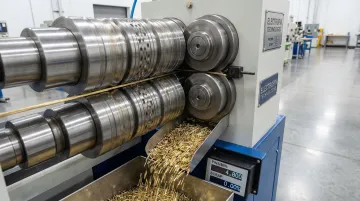
Electropin is the only custom contact pin manufacturer leveraging proprietary automatic die rolling technology—a cold-forming process that eliminates scrap production entirely. Unlike machining, which cuts away material and dulls tools progressively, die rolling pushes raw material into custom dies to conform to the desired shape. No cutting means no blunted parts, no scrap sent to recycling, and no tool degradation.
Tools maintain sharpness from part 1 to part 1,000,000, enabling a documented defect rate of just 1 in 600,000,000 pins. All parts are lead-free and fully REACH/RoHS compliant without requiring leaded brass.
| Manufacturing Technology | Proprietary automatic die rolling — no machining, no cutting, no scrap |
|---|---|
| Production Speed & Quality | Up to 5 custom connector pins per second; defect rate of 1 in 600,000,000 |
| Compliance & Lead Time | Lead-free, REACH and RoHS compliant; first batch delivery sometimes within 2 weeks |
Mill-Max Manufacturing Corp.
Founded in 1971 by Roger L. Bahnik, Mill-Max operates a vertically integrated 150,000 square foot facility in Oyster Bay, NY. The company produces over 100 million interconnect components per week using precision high-speed turning and Swiss screw CNC machining. Mill-Max specializes in low-to-medium volume custom geometries and rapid prototyping, offering unique multi-faceted (polygon) press-fit shapes and hollow, slotted compliant tails designed to prevent damage to plated through-holes.
Differentiators:
Mill-Max's Swiss screw machining enables tight tolerances and complex geometries unachievable through stamping. Their press-fit pins feature precision-machined compliance zones that accommodate PCB hole tolerances while maintaining retention force. The company serves defense, medical, industrial, and consumer electronics with materials including phosphor bronze, stainless steel, and brass alloys.
| Industries Served | Defense, medical, industrial, consumer electronics |
|---|---|
| Manufacturing Technology | Swiss screw CNC machining, high-speed precision turning |
| Certifications | ISO 9001, RoHS, REACH |
Interplex Industries
Founded in 1958 in Flushing, NY, Interplex operates significant US manufacturing facilities including College Point, NY. The company specializes in high-precision stamping and molding, producing solderless press-fit terminals designed for high-speed automation. Interplex's terminals feature industry-proven 0.64mm and 0.8mm press-fit zones qualified for harsh automotive applications operating at temperatures up to 150°C.
Differentiators:
Interplex's high-precision progressive die stamping delivers the volume scalability required for automotive Tier 1 suppliers. Their press-fit terminals support automated insertion with force-distance monitoring, ensuring consistent seating without PCB damage. The company's IATF 16949 certification and ISO 13485 compliance position them for both automotive and medical device applications.
| Industries Served | Automotive, medical, aerospace, datacom |
|---|---|
| Manufacturing Technology | High-precision progressive die stamping |
| Certifications | IATF 16949, ISO 13485, ISO 9001, RoHS |
TE Connectivity (US Operations)
TE Connectivity maintains a massive US footprint with 89 locations nationwide, employing approximately 26,000 people in the Americas region. Headquartered in Berwyn, PA, TE pioneered press-fit technology and offers two distinctive compliant pin designs: the ACTION PIN and the Multispring. These are heavily utilized in automotive engine management, ABS/ESC systems, and industrial control modules.
Differentiators:
TE's press-fit connectors are engineered for high-reliability applications requiring IATF 16949 certification and zero-defect mandates. Their Multispring design distributes contact force across multiple compliance zones, reducing insertion force while maintaining retention strength. TE's global supply chain and local US manufacturing provide both scalability and responsiveness.
| Industries Served | Automotive, aerospace, industrial, medical |
|---|---|
| Manufacturing Technology | Precision stamping, automated assembly |
| Certifications | IATF 16949, AS9100, UL, RoHS, REACH |
Molex (US Manufacturing)
Founded in 1938, Molex operates major US manufacturing facilities including a long-standing Lincoln, Nebraska plant established in 1977. The company specializes in high-speed datacom and server applications, featuring press-fit backplane connectors like the Impel, Impulse (supporting up to 112Gbps), and DDR4 DIMM vertical press-fit connectors.
Differentiators:
Molex's press-fit connectors are optimized for signal integrity in high-speed data transmission. Their Impel series delivers differential impedance control and low insertion loss, critical for backplane applications in data centers and telecommunications infrastructure. IATF 16949 and AS9100 certifications support both automotive and aerospace markets.
| Industries Served | Data centers, telecommunications, automotive, medical |
|---|---|
| Manufacturing Technology | Precision stamping, high-speed assembly |
| Certifications | IATF 16949, AS9100, ISO 9001, RoHS, REACH |
Amphenol (US Operations)
Founded in 1932 and headquartered in Wallingford, CT, Amphenol operates extensive US manufacturing across New York, Florida, and Massachusetts. The company offers ruggedized press-fit solutions including the Centaur High Bandwidth 38999 PCB Connectors (featuring compliant eye press-fit tails), XCede backplane connectors, and D-Sub press-fit connectors.
Differentiators:
Amphenol's press-fit connectors are engineered for harsh environments requiring MIL-DTL-38999 approvals and AS9100 certification. Their Centaur series delivers high-bandwidth performance in aerospace and defense applications where vibration, thermal cycling, and EMI shielding are critical. The compliant eye design distributes stress to prevent PCB barrel cracking.
| Industries Served | Aerospace, military, defense, industrial |
|---|---|
| Manufacturing Technology | Precision stamping, CNC machining, automated assembly |
| Certifications | AS9100, ISO 9001, MIL-DTL-38999, RoHS, REACH |
Cinch Connectivity Solutions
Acquired by Bel Fuse in 2010, Cinch is headquartered in Lombard, IL, with additional US facilities in Florida, Texas, and Minnesota. The company offers the CIN::APSE solderless Z-axis compression connector technology, Stewart RJ45 press-fit connectors, and DIN 41612 press-fit plugs designed for military, aerospace, space, and telecommunications applications.
Differentiators:
Cinch's CIN::APSE technology provides high-density Z-axis interconnections without soldering, ideal for stacked PCB assemblies in space-constrained applications. Their Stewart RJ45 press-fit connectors eliminate wave soldering in Ethernet infrastructure, reducing thermal stress on multilayer boards. AS9100D certification supports aerospace and defense programs.
| Industries Served | Military, aerospace, space, telecommunications |
|---|---|
| Manufacturing Technology | Precision stamping, compression interconnect assembly |
| Certifications | AS9100D, ISO 9001, RoHS |
Winchester Electronics
Headquartered in Milford, CT, Winchester Interconnect operates multiple US facilities serving military, aerospace, medical, and harsh industrial environments. The company utilizes C-Press compliant pin technology in SMA and BNC coaxial connectors, as well as power terminals, providing high retention force without soldering.
Differentiators:
Winchester's C-Press technology delivers military-grade reliability in RF and power applications where soldering introduces thermal stress and signal integrity degradation. Their press-fit coaxial connectors maintain controlled impedance and shielding effectiveness while eliminating cold solder joints. AS9100 certification supports aerospace and defense qualification requirements.
| Industries Served | Military, aerospace, medical, harsh industrial |
|---|---|
| Manufacturing Technology | Precision stamping, CNC machining |
| Certifications | AS9100, ISO 9001 |
Keystone Electronics
Established in 1950 and headquartered in New Hyde Park, NY (formerly Astoria), Keystone Electronics utilizes progressive die stamping, fourslide wire forming, and precision turning/machining to produce precision hardware, micro pins, and square/knurled press-fit PCB pins. The company supports rapid sourcing through comprehensive standard catalogs.
Differentiators:
Keystone's extensive catalog of standard press-fit pins enables rapid prototyping and low-volume production without custom tooling costs. Their knurled and square press-fit geometries provide anti-rotation features for applications requiring precise pin orientation. ISO 9001:2015 certification and RoHS/REACH compliance support diverse industrial and medical applications.
| Industries Served | Consumer electronics, industrial, medical |
|---|---|
| Manufacturing Technology | Progressive die stamping, fourslide forming, precision turning |
| Certifications | ISO 9001:2015, RoHS, REACH |
Smiths Interconnect (US Operations)
A division of UK-based Smiths Group, Smiths Interconnect operates US manufacturing facilities in Salisbury, MD; Kansas City, KS; and Tampa, FL. The company specializes in high-reliability interconnects, offering the HyperStac series for Z-axis interconnections and cPCI Press-Fit connectors utilizing proprietary Hyperboloid contact technology.
Differentiators:
Smiths Interconnect's Hyperboloid contact geometry delivers multiple points of contact per pin, distributing current and reducing contact resistance. Their cPCI press-fit connectors are NASA S311 qualified, ensuring interoperability with space-grade solder tail versions. AS9100D and ISO 13485 certifications support both aerospace and medical device applications.
| Industries Served | Space, defense, commercial aerospace, medical |
|---|---|
| Manufacturing Technology | Precision machining, Hyperboloid contact forming |
| Certifications | AS9100D, ISO 13485, ISO 9001, RoHS |
How We Chose the Best Compliant Pin Manufacturers in the US
Procurement teams often select compliant pin suppliers based solely on unit price — overlooking consistency across production runs, documented defect rates, and the real cost of scrap or rework downstream. A $0.05 savings per pin becomes irrelevant when a single defective connector triggers costly equipment downtime.
The criteria below reflect what actually separates reliable suppliers from ones that create problems after the PO is signed.
Key Selection Factors:
- Manufacturing process: Die-rolled pins maintain dimensional consistency across millions of parts because no cutting tool dulls over time. Machined pins are prone to drift as tooling degrades — which matters when you're ordering at volume.
- Defect rate documentation: Automotive OEMs increasingly require 0 PPM targets. Ask suppliers for Cpk process capability metrics and force-distance insertion monitoring data before approving a source.
- Material traceability: RoHS/REACH compliance requires lead-free formulations. Confirm suppliers provide material declarations and certificates of conformance with each shipment.
- Industry certifications: IATF 16949 covers automotive, AS9100 covers aerospace, and ISO 13485 applies to medical devices. Certifications validate process controls — not just the product spec on paper.
- Lead times and volume scalability: Reliable suppliers can deliver initial batches within two weeks and ramp production without quality degradation when demand increases.
- DFM engineering support: Manufacturers who offer design-for-manufacturability consultation can optimize pin geometry for insertion force, PCB stress, and manufacturability — often reducing costs without changing function.
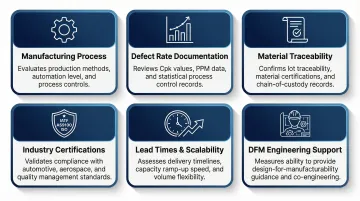
The ability to offer DFM guidance separates full-service manufacturers from simple quote-and-ship vendors. Ask whether a supplier will review your specifications and flag opportunities to improve performance or reduce cost — that conversation alone tells you a lot about who you're working with.
Conclusion
Your choice of compliant pin manufacturer affects field reliability, regulatory standing, and total production cost. A poorly matched supplier introduces rework, scrap, audit failures, and field failures that quickly outpace any savings on unit price.
Evaluate suppliers on:
- Documented defect rates and run-to-run consistency validated through statistical process control
- Compliance documentation that holds up under audit scrutiny
- Ability to scale production volumes without quality degradation
- Force-distance insertion monitoring data provided for every lot
For buyers who need custom compliant pins with near-zero defects, scrap-free production, and lead times as short as two weeks, Electropin's proprietary die rolling technology offers a differentiated and proven solution. Contact Electropin at +1 919-288-1203 to discuss your specifications with their Design for Manufacturing experts.
Frequently Asked Questions
What are compliant pins used for?
Compliant pins are press-fit into plated through-holes on PCBs to create solderless, mechanically secure electrical connections. They're used in automotive control modules, medical devices, industrial equipment, and backplane connectors where vibration resistance and thermal reliability are critical.
What is the difference between compliant pins and pogo pins?
Compliant pins work through elastic interference fit into a PCB hole, creating a permanent or semi-permanent connection. Pogo pins are spring-loaded contacts designed for repeated mating and unmating cycles, such as in test fixtures or charging docks.
How do I evaluate a US compliant pin manufacturer before ordering?
Assess documented defect rates, manufacturing method (machining vs. die rolling), RoHS/REACH compliance documentation, ability to produce custom geometries, and lead time commitments. Request Cpk process capability metrics and force-distance insertion monitoring data for production lots.
What materials are compliant pins typically made from?
Common base materials include phosphor bronze, beryllium copper, and brass, with plating options like gold, nickel, or tin. Material choice affects conductivity, corrosion resistance, and compliance with RoHS regulations. Lead-free formulations are available from reputable US manufacturers.
Are compliant pins RoHS and REACH compliant?
Compliance depends on the manufacturer and the specific materials used. Always request material declarations and compliance certificates before ordering to verify regulatory conformance.
What industries rely most heavily on compliant pins?
Automotive (ECUs, powertrain connectors), medical devices (diagnostic and monitoring equipment), industrial automation, aerospace/defense, and computer/server backplane assemblies. These sectors prioritize solderless connections to reduce thermal stress and assembly complexity.