Introduction
Engineers and procurement teams sourcing PCB connector pins domestically face a complex challenge: balancing precision manufacturing, rapid delivery, predictable lead times, and regulatory compliance in a market where decades of offshoring have created supply chain vulnerabilities. A May 2025 IPC survey found that 65% of electronics manufacturers are experiencing rising material costs, while 53% report tariff uncertainty is delaying sourcing decisions.
Connector pins—the individual metal contact elements within a connector—directly impact PCB performance across automotive, medical devices, computing, and industrial equipment. Manufacturing method determines defect rates, dimensional consistency, and total cost.
The gap is significant: machining produces roughly four parts per minute with up to 65% scrap, while cold-forming yields 150–400 parts per minute with near-zero waste. Knowing who uses which process helps you evaluate the right supplier for your application.
The US hosts manufacturers ranging from global connector companies with domestic facilities (Amphenol, Molex, TE Connectivity) to specialized custom pin makers offering technologies unavailable overseas. The profiles below break down each manufacturer's capabilities, processes, and best-fit use cases.
Key Takeaways
- PCB connector pins are precision metal contacts that carry signal or power between boards and mating components—quality directly affects electrical performance and product longevity
- The US market spans large-scale manufacturers and niche custom producers, with cold-forming and die-rolling technologies setting quality leaders apart
- Domestic sourcing delivers shorter lead times, simplified REACH/RoHS compliance, and direct quality control visibility
- Evaluate manufacturers on process technology, defect rates, material compliance, and capacity to scale with your production needs
- Top-tier custom pin manufacturers achieve defect rates as low as 1 in 600,000,000—automatic die-rolling is the technology making that possible
Overview of PCB Connector Pins in the US Electronics Market
PCB connector pins—also called contact pins—are precision-machined or formed metal components that establish electrical contact between a printed circuit board and a cable, wire, or mating connector. Unlike the full connector housing assembly, pins are the individual contact elements responsible for signal integrity and current carrying capacity.
The global PCB connector market was valued at over $12.9 billion in 2023 and is projected to reach $17.5 billion by 2032, growing at a 3.6% CAGR. North America accounts for 32.5% of the board-to-board connector market.
Demand from electric vehicles, 5G networks, IoT devices, and AI technologies is pushing requirements toward higher-precision, lead-free, and miniaturized pin solutions.
Two dominant manufacturing approaches exist:
- CNC precision machining – Cutting tools remove material to create the final shape, producing approximately 4 parts per minute with up to 65% scrap and progressive tool wear that causes dimensional drift
- Cold-forming/die-rolling – Material is shaped by progressive dies without cutting or heat, achieving 150–400 parts per minute with near-zero scrap and no tool dulling
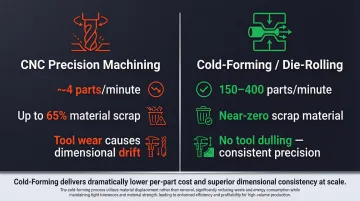
The method a manufacturer uses directly affects cost, consistency, scrap rate, and production speed—all worth weighing as you compare suppliers.
Top 10 PCB Connector Pin Manufacturers in the US
These manufacturers were evaluated based on US manufacturing presence, technical capability, product range, industry reputation, customization support, and ability to serve high-reliability applications. The list spans custom contact specialists, precision machined interconnect producers, and large-scale connector system suppliers — covering the full range of what industrial OEMs typically need from a domestic pin source.
Electropin (Autoswage Products, Inc.)
Founded in 1943 in Connecticut and now headquartered in North Carolina, Electropin is a third-generation family manufacturer that evolved from fluorescent lightbulb pins into a premier custom contact pin producer serving automotive, medical, computer, and farm equipment industries.
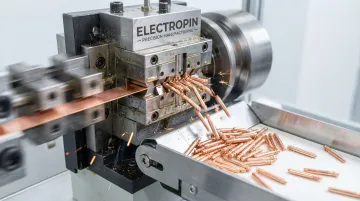
Differentiator: Electropin's proprietary automatic die-rolling technology eliminates the cutting and heating required in machining. Tools never dull, there is zero scrap (material in equals material out), and the process produces up to five custom connector pins per second with a verified defect rate of just 1 in 600,000,000. Parts are lead-free without needing leaded brass, removing REACH and RoHS concerns entirely.
| Attribute | Details |
|---|---|
| HQ / Manufacturing Location | North Carolina, USA |
| Key Specialization | Custom contact pins via die-rolling; automotive, medical, computing, industrial |
| Notable Capability | Up to 5 pins/second; zero-scrap production; first batch delivery in as little as two weeks |
Mill-Max Mfg. Corp.
Based in Oyster Bay, New York, Mill-Max has been a US precision machined interconnect specialist since 1971, manufacturing pins, sockets, connectors, and spring-loaded contacts used in aerospace, medical, telecommunications, and industrial electronics. The company holds ISO 9001:2015 certification and ITAR registration.
Differentiator: Mill-Max's proprietary high-speed CNC turning machines allow custom machined contacts in a broad range of sizes and configurations at volume. The company is known for tight dimensional tolerances and a deep catalog of through-hole and surface-mount pin options.
| Attribute | Details |
|---|---|
| HQ / Manufacturing Location | Oyster Bay, New York, USA |
| Key Specialization | Precision-machined pins, sockets, spring-loaded contacts |
| Notable Capability | High-volume custom machining; extensive standard catalog for rapid specification |
Samtec Inc.
Samtec, headquartered in New Albany, Indiana, was founded in 1976 and has grown into a global interconnect company with US manufacturing spanning pin headers, female headers, and high-speed board-to-board connectors.
Differentiator: Samtec offers same-day shipping on over 200,000 catalog parts through its Reserve™ program, strong signal integrity engineering support, and design tools that allow rapid prototyping. Design engineers who need fast iteration on pin connector configurations frequently turn to Samtec for that reason.
| Attribute | Details |
|---|---|
| HQ / Manufacturing Location | New Albany, Indiana, USA |
| Key Specialization | Pin headers, high-speed interconnects, board-to-board and wire-to-board pins |
| Notable Capability | Same-day shipping; signal integrity engineering support; rapid prototype service |
Amphenol Corporation
Founded in 1932 and headquartered in Wallingford, Connecticut, Amphenol is one of the world's largest connector manufacturers with major domestic manufacturing operations. It serves aerospace, automotive, military, industrial, and data communications markets.
Differentiator: Amphenol's US operations include high-reliability military and aerospace connector pin production, deep certification portfolio (MIL-SPEC, AS9100:D, ISO 9001:2015, ITAR-registered), and the scale to support large OEM programs with tight tolerances and traceability requirements.
| Attribute | Details |
|---|---|
| HQ / Manufacturing Location | Wallingford, Connecticut, USA (global operations) |
| Key Specialization | High-reliability connector pins for military, aerospace, automotive, and industrial PCB applications |
| Notable Capability | MIL-SPEC certified production; ITAR-registered; large-scale OEM program support |
Molex
Molex, headquartered in Lisle, Illinois, and a subsidiary of Koch Industries since a $7.2 billion acquisition in 2013, was founded in 1938 and operates manufacturing and engineering facilities across the US. It is a leading supplier of connector systems including pin headers and contact components for automotive, data center, and consumer electronics applications.
Differentiator: Molex invests heavily in high-speed signal integrity and miniaturization R&D. Its US-based engineering teams provide design-in support and the company maintains domestic manufacturing for programs requiring supply chain security or US-origin compliance.
| Attribute | Details |
|---|---|
| HQ / Manufacturing Location | Lisle, Illinois, USA |
| Key Specialization | Pin headers, fine-pitch contacts, high-speed and automotive connector systems |
| Notable Capability | Strong design-in engineering support; US-origin compliance capability; extensive R&D investment |
TE Connectivity
TE Connectivity maintains large-scale manufacturing and engineering operations in the US and is a major domestic supplier of connector pins and contact systems for automotive, aerospace, industrial, and medical applications. The company changed its domicile from Switzerland to Ireland in 2024.
Differentiator: TE's US facilities support high-volume production with tight quality controls, IPC and automotive (IATF 16949) certifications, and a broad product range from standard pin headers to custom stamped and formed contacts for harsh-environment applications.
| Attribute | Details |
|---|---|
| HQ / Manufacturing Location | Major US manufacturing (multiple states); global HQ in Ireland |
| Key Specialization | Stamped/formed and machined contact pins; harsh-environment and automotive-grade connector systems |
| Notable Capability | IATF 16949 and IPC-certified facilities; broad portfolio from standard to custom contact pins |
Winchester Electronics
Winchester Electronics, headquartered in Milford, Connecticut, is a US manufacturer with a long history in high-reliability PCB connectors and contact pins for military, defense, aerospace, and industrial markets.
Differentiator: Winchester specializes in mil-spec and VITA standard interconnects. The company is ITAR-registered and offers US-made contact pin components for programs where domestic supply chain documentation is a requirement.
| Attribute | Details |
|---|---|
| HQ / Manufacturing Location | Milford, Connecticut, USA |
| Key Specialization | Mil-spec PCB connector pins; VITA standard and high-reliability defense/aerospace contacts |
| Notable Capability | ITAR-registered; domestic manufacture for defense program compliance |
Cinch Connectivity Solutions
Cinch Connectivity Solutions, part of Bel Fuse Inc. and based in Lombard, Illinois, manufactures a range of PCB connectors and contact pins serving industrial, military, and telecommunications applications with US production capabilities. Bel Fuse acquired Cinch from Safran S.A. in 2010 for $39 million.
Differentiator: Cinch is known for its modular and high-density PCB contact systems, with a legacy in MIL-SPEC connector manufacturing that makes it a strong choice for defense electronics programs requiring traceable, domestically produced pin components.
| Attribute | Details |
|---|---|
| HQ / Manufacturing Location | Lombard, Illinois, USA |
| Key Specialization | High-density PCB contacts; MIL-SPEC and industrial connector pins |
| Notable Capability | Modular high-density pin solutions; defense-grade traceability |
Positronic
Positronic, headquartered in Springfield, Missouri, has been manufacturing high-reliability connectors and contact pins since 1966, serving aerospace, defense, medical, and industrial electronics markets with US-made components.
Differentiator: Positronic produces connectors with mixed contact arrangements — signal, power, and coaxial within a single housing — and maintains stringent quality controls aligned with AS9100 and IATF 16949 standards for demanding application environments.
| Attribute | Details |
|---|---|
| HQ / Manufacturing Location | Springfield, Missouri, USA |
| Key Specialization | High-reliability and mixed-contact connector pins; aerospace, medical, and defense applications |
| Notable Capability | AS9100 and IATF 16949 certified; mixed-contact configurations for complex PCB designs |
CUI Devices (Same Sky)
CUI Devices, headquartered in Lake Oswego, Oregon, offers a broad portfolio of PCB connectors and interconnect components including pin headers and terminal blocks, targeting industrial, medical, and consumer electronics designers in North America.
Differentiator: CUI Devices stands out through strong distributor availability, detailed online design resources, and a product line built for rapid specification by design engineers. For design engineers sourcing lower-volume or prototype-stage PCB connector pins, that combination of accessibility and documentation depth is genuinely useful.
| Attribute | Details |
|---|---|
| HQ / Manufacturing Location | Lake Oswego, Oregon, USA |
| Key Specialization | PCB pin headers, terminal blocks, and board-mount connectors for industrial and medical applications |
| Notable Capability | Wide distributor network; detailed datasheets and engineering selection tools for fast specification |
How We Chose the Best PCB Connector Pin Manufacturers
This list was evaluated against criteria most relevant to buyers sourcing connector pins for production applications:
- US manufacturing presence or domestic origin capability
- Manufacturing technology and its effect on defect rate and consistency
- Depth of customization support
- Relevant industry certifications
- Scalability from prototype to high-volume production
Brand name alone won't tell you whether a manufacturer can hold tolerances at part one million the way they did at part one.
Manufacturing Method: The Overlooked Differentiator
Die-rolling, CNC machining, and stamping each produce different outcomes—yet most buyers never ask which process a manufacturer uses. Machining produces scrap and tool wear that affects consistency across long production runs. As cutting tools dull, dimensional tolerances drift.
Spindle thermal expansion alone can shift dimensions by 0.02mm, requiring active compensation and SPC tracking to catch drift before it becomes a defect.
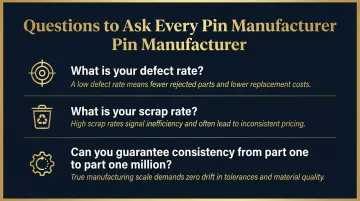
Alternative methods like die-rolling eliminate both scrap and tool wear entirely—which is why process transparency matters when evaluating suppliers. Ask any manufacturer specifically about:
- Defect rates
- Scrap rates
- How consistency is maintained from part one to part one million
Compliance Considerations
REACH and RoHS compliance is easier to manage with domestic manufacturers using lead-free alloys and documented material traceability. Two deadlines OEMs should already have on their radar:
- EU RoHS Exemption 6(c), which permits up to 4% lead in copper/brass alloys, expires June 30, 2027
- Lead remains on the ECHA REACH Candidate List, triggering supplier notification obligations at 0.1% w/w
Domestic sourcing reduces this compliance burden for OEMs selling into regulated markets.
Conclusion
The US PCB connector pin manufacturing landscape runs from large global connector companies with domestic capacity all the way to specialized custom manufacturers with proprietary processes built around specific applications. The right choice depends on your production volume, customization needs, regulatory requirements, and target application.
Evaluate not just product specs but the underlying manufacturing process, defect history, material compliance documentation, and lead time track record before committing to a production partner.
For buyers who need custom contact pins with near-zero defects at production scale—particularly for automotive, medical, or computing applications—Electropin's automatic die-rolling technology produces up to five pins per second, with a defect rate of 1 in 600,000,000, and no scrap. With over 80 years of manufacturing history behind that process, it's a natural first call. Contact the team at Electropin to discuss your design requirements.
Frequently Asked Questions
Are there any PCB manufacturers in the USA?
Yes, the US has a well-established PCB connector pin manufacturing sector. Domestic manufacturers include Electropin, Mill-Max, Samtec, Amphenol, Molex, TE Connectivity, and Positronic. Domestic sourcing offers supply chain security, simplified compliance documentation, and direct quality control visibility.
What is the difference between a PCB connector pin and a PCB connector?
The connector pin (or contact pin) is the individual metal element that makes the electrical contact. The connector is the full assembly including housing, contacts, and mechanical retention features. Manufacturers like Electropin and Mill-Max specialize specifically in the precision contact pin components.
How are custom PCB connector pins manufactured?
Custom pins are made using two primary methods: CNC precision machining (material is cut and shaped, producing scrap and subject to tool wear) and die-rolling/cold-forming (material is shaped without cutting or heat, producing no scrap and maintaining tool consistency). Die-rolling achieves higher production speeds and eliminates dimensional drift from tool wear.
What materials are commonly used in PCB connector pins?
Common base materials include brass, phosphor bronze, and beryllium copper, with gold, tin, or nickel platings for conductivity and corrosion resistance. Lead-free alloys satisfy REACH and RoHS requirements, though switching from C36000 to C69300 brass drops conductivity from 26% IACS to 8% IACS, requiring thermal and electrical derating.
What certifications should I look for in a PCB connector pin manufacturer?
Look for ISO 9001 (quality management), IATF 16949 (automotive), AS9100 (aerospace), UL listings, and ITAR registration for defense work. Always request REACH and RoHS compliance documentation, and confirm certifications through IAF CertSearch to verify the issuing body is accredited.
How quickly can a US PCB connector pin manufacturer deliver custom parts?
Lead times vary by manufacturer and process. Forming-technology specialists like Electropin can deliver first-batch custom pins in as little as two weeks when raw materials are available, while machined parts typically carry longer tooling setup times. Samtec's quick-ship program covers standard catalog items in one day.