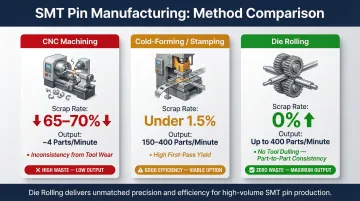
SMT contact pins enable consistent electrical conductivity and precise fit in molded assemblies while meeting REACH and RoHS environmental standards. However, manufacturing method—whether CNC machining, progressive stamping, or die rolling—has a direct impact on defect rates, material waste, and dimensional consistency across production runs. Machining can generate 65-70% scrap and suffers from tool wear that degrades part quality, while cold-forming methods achieve scrap rates below 1% and maintain consistency from the first part to the millionth.
This guide covers the top SMT pin manufacturers operating in the US, what sets each apart in terms of technology and capability, and what buyers should evaluate before selecting a supplier.
Key Takeaways
- SMT pins are precision contact pins soldered onto PCBs or inserted into connectors, used across automotive, medical, computing, and industrial applications
- Manufacturing method drives cost: cold-forming produces <1% scrap at up to 400 parts/minute; machining wastes 65-70% of material at ~4 parts/minute
- Electropin achieves 1 defect per 600 million pins — the only US manufacturer using proprietary automatic die rolling with zero scrap
- Key selection criteria: manufacturing technology, defect rates, REACH/RoHS compliance, customization capability, delivery timelines
- All manufacturers listed are US-based with established presence in electronics and connector applications
What Are SMT Pins and Why Do They Matter for US Manufacturers?
SMT pins are solid custom contact pins—distinct from spring-loaded pogo pins—designed for surface mounting on PCBs or insertion into connector housings. They establish reliable electrical contact between components in assembled products, serving as the critical interface in automotive harnesses, medical device connectors, circuit board assemblies, and industrial equipment.
The global contact pin market is projected to reach $700 million by 2033, growing at a 5% CAGR from $500 million in 2025. That growth mirrors the US mechanical connectors market, valued at $2.38 billion in 2025 and expected to reach $3.86 billion by 2035. Key industries driving this demand include:
- Automotive electronics – Electric and hybrid vehicles require higher-density contact pins for complex EV systems
- Aerospace and defense – High-reliability requirements sustain premium demand
- Telecommunications and data centers – 5G infrastructure expansion fuels high-performance contact pin needs
- Medical devices – Diagnostic equipment, patient monitoring, and implantable devices require mission-critical pin quality
Wiring harness and connector defects accounted for 84% of automotive electrical recalls in China in 2021, affecting 8.73 million vehicles. In data centers, a degraded connector can cause downtime costing thousands of dollars per minute. The financial exposure of a single failed SMT pin outweighs any component savings—which is why procurement decisions need to account for quality, not just unit price.
Top 10 SMT Pins Manufacturers in the US
These manufacturers were selected based on manufacturing technology, production consistency, US market presence, industry certifications, and ability to deliver custom contact pins across demanding applications. Each entry covers the core factors that matter most in a sourcing decision: how parts are made, what tolerances are achievable, and which industries each supplier actually serves.
Electropin (Autoswage Products, Inc.)
Headquartered in North Carolina and operating since 1943 (originally as Autoswage Products, Inc.), Electropin is a three-generation family business manufacturing custom contact pins for automotive, medical, computing, farm equipment, and PCB connector applications. The company relocated to North Carolina and rebranded as Electropin in 2019.
Today, Keith Brenton — with over 35 years of customer-focused design and manufacturing experience — runs the operation and continues refining the proprietary process that defines the company.
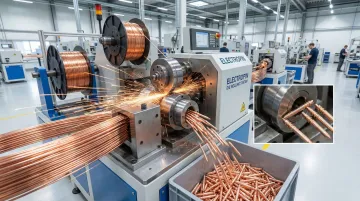
Electropin is the only US contact pin manufacturer to use proprietary automatic die rolling technology. This cold-forming process requires no cutting, generates zero scrap, produces up to five pins per second, and maintains tool consistency from part one to part one million. The result: a documented defect rate of just 1 in 600,000,000 pins. All pins are lead-free and fully REACH/RoHS compliant with no exceptions.
| Manufacturing Technology | Proprietary automatic die rolling — no cutting, no heat, no scrap; tools never dull, ensuring part-to-part consistency across the entire production run |
|---|---|
| Production Speed & Lead Time | Up to 5 custom connector pins per second; first batch delivery sometimes achievable in as little as two weeks |
| Compliance & Quality | Defect rate of 1 in 600,000,000; lead-free production with no REACH or RoHS compliance concerns; scrap-free — 100% of purchased material becomes finished pins |
Mill-Max Manufacturing Corp.
Founded in 1971 and based in Oyster Bay, NY, Mill-Max is a vertically integrated manufacturer of precision-machined contacts, pins, and interconnects. All manufacturing processes—screw machine turning, stamping, plating, and assembly—are housed under one roof. Their SMT-compatible product lines include solid PCB pins and Sure-Hold Surface Mount PCB Pins, which feature machined grooves in the base to promote capillary action and optimal solder flow.
Mill-Max utilizes CNC high-speed turning to achieve tolerances of +/-.0005" using materials like brass (Alloy 360/385), phosphor bronze (Alloy 544), tellurium copper, and beryllium copper. They hold ISO 9001 certification and comply with RoHS and REACH regulations.
| Manufacturing Technology | CNC precision turning with in-house tooling; tolerances to +/-.0005" |
|---|---|
| Key Product Offerings | SMT pins, precision contacts, custom interconnects, Sure-Hold surface mount pins |
| Industries & Compliance | Aerospace, medical, military, industrial; ISO 9001, RoHS, REACH |
Keystone Electronics Corp.
Established in 1946 and headquartered in New Hyde Park, NY, Keystone Electronics is a manufacturer of precision electronic components and PCB hardware. Their SMT-specific product lines include SMT test points, SMT pins, and PCB terminals. Manufacturing capabilities include close tolerance stamping, machining, and assembly, and they are ISO 9001:2015 certified and RoHS compliant.
| Manufacturing Technology | Stamping and machining methods for close-tolerance components |
|---|---|
| Key Product Offerings | SMT test points, pins, terminals, PCB hardware |
| Industries & Compliance | Consumer electronics, industrial, telecom; ISO 9001:2015, RoHS |
Zierick Manufacturing Corp.
Founded in 1919 and operating out of Mount Kisco, NY, Zierick Manufacturing specializes in SMT terminals, solid pins, and press-fit pins. They design and run progressive dies for high-speed stamping, and their proprietary SMT mounting technology includes the SMT Z-Axis Compliant Pin, which compensates for thermal expansion and contraction. They are ISO 9001:2015 certified and comply with RoHS 3 and REACH regulations.
| Manufacturing Technology | High-speed stamping with progressive dies; proprietary Z-Axis compliant pin technology |
|---|---|
| Key Product Offerings | SMT pins, PC board terminals, connector hardware, press-fit pins |
| Industries & Compliance | Automotive, medical, industrial, telecom; ISO 9001:2015, RoHS 3, REACH |
Samtec Inc.
Founded in 1976 and headquartered in New Albany, Indiana, Samtec is a privately owned global manufacturer with US manufacturing facilities in Indiana, Colorado, Pennsylvania, and California. Their SMT-specific contact lines include the Edge Rate contact system, which features a milled surface to reduce wear tracks and increase cycle life, and the TSM series of .025" square post surface mount terminal strips. Samtec holds ISO 9001, IATF 16949, and ITAR registrations.
| Manufacturing Technology | Precision stamping and machining; advanced milling for high-cycle contact systems |
|---|---|
| Key Product Offerings | SMT pins, high-speed connectors, custom interconnects, terminal strips |
| Industries & Compliance | Data communications, medical, defense, computing; ISO 9001, IATF 16949, ITAR |
Interplex Industries
Founded in 1958 and privately held by Blackstone, Interplex operates multiple US facilities including sites in Northvale, NJ, and Attleboro, MA. They specialize in precision metal stamping, cold forging, and press-fit terminals. Their US facilities hold IATF 16949 and ISO 13485 certifications, catering heavily to automotive, medical, and data center markets.
| Manufacturing Technology | Precision metal stamping and cold forging; progressive die technology |
|---|---|
| Key Product Offerings | Custom contact pins, stamped metal components, solderless press-fit terminals |
| Industries & Compliance | Automotive, medical, data center, telecom; IATF 16949, ISO 13485, RoHS |
TE Connectivity (US Operations)
TE Connectivity maintains extensive US manufacturing for medical and aerospace contacts, including ISO 13485-certified facilities in Denver, CO, and Wilsonville, OR, alongside numerous IATF 16949-certified plants across Pennsylvania, North Carolina, and California. Their solid SMT offerings include DEUTSCH solid contacts and surface-mount device (SMD) headers.
| Manufacturing Technology | Stamping and cold forming at US facilities; advanced plating capabilities |
|---|---|
| Key Product Offerings | SMT pins, PCB contacts, connector assemblies, DEUTSCH solid contacts |
| Industries & Compliance | Automotive, aerospace, medical, industrial; IATF 16949, ISO 9001, ISO 13485 |
Molex (US Operations)
Founded in 1938, Molex operates US facilities in Lisle, IL, Lake City, PA, and Taunton, MA, holding AS9100D and ISO 13485 certifications. Their SMT contact lines include FCT SMT D-Sub Connectors and advanced press-fit pins designed for automotive and medical applications.
| Manufacturing Technology | Stamping and machining; specialized press-fit technology for automotive |
|---|---|
| Key Product Offerings | SMT pins, PCB contacts, wire-to-board connectors, D-Sub connectors |
| Industries & Compliance | Telecom, medical, automotive, data center; ISO 9001, ISO 13485, AS9100D |
How We Selected These SMT Pin Manufacturers
These manufacturers were assessed on US manufacturing presence, production technology and consistency, ability to supply custom contact pins, REACH/RoHS compliance posture, delivery capability, and track record in demanding industries like automotive, medical, and electronics.
Common Buyer Mistakes to Avoid
Many buyers prioritize unit price over defect rates, overlooking how scrap-related cost inflation in machining-based production drives total cost higher. With machining generating 65-70% scrap, customers effectively pay for material that goes straight to the scrapyard.
Compliance is the other common blind spot. Two regulatory deadlines deserve attention before sourcing:
- RoHS Exemption 6(c), which permits up to 4% lead in copper alloys, expires December 31, 2026
- REACH Article 33 requires supply chain notification within 45 days if a product contains >0.1% of a Substance of Very High Concern
Why Manufacturing Method Matters
The method used to make a pin directly determines its consistency across a full production run. In machined production, cutting tool edges dull with every part produced — so pins from the start of a batch won't match pins from the end, and scrap rates of 65-70% are common.
Cold-forming and stamping close that gap considerably:
- Cold-forming and die rolling achieve scrap rates below 1% and production speeds of 150-400 parts per minute
- High-volume stamping with precision dies holds scrap under 1.5% and first-pass yields above 99.5%
Conclusion
Choosing the right SMT pin manufacturer affects defect rates, compliance risk, production consistency, and supply chain reliability across the full production lifecycle. Price per pin is one factor — but it rarely tells the whole story.
Evaluate manufacturers on:
- Defect history and documented scrap rates
- Customization capability for your geometry and tolerances
- Lead times, including first-batch turnaround
- Compliance posture (RoHS, REACH)
- Track record in your specific industry vertical
For buyers seeking a US-based SMT pin manufacturer that combines 80+ years of cold-forming expertise with proprietary die rolling technology and a verified defect rate of just 1 in 600,000,000, contact Electropin at +1 919-288-1203 to discuss your requirements.
Frequently Asked Questions
What is the difference between SMT pins and pogo pins?
SMT pins are solid contact pins designed for surface mounting or insertion into connectors and PCBs, while pogo pins are spring-loaded and used for temporary, compressible contact. SMT pins are the choice for permanent or semi-permanent connector assemblies where consistent, durable contact is required.
What manufacturing processes are used to make SMT pins?
Common methods include CNC machining, metal stamping, cold-forming, and die rolling. Die rolling is the most material-efficient method, producing no scrap with tools that do not dull over production runs. CNC machining, by contrast, produces 65-70% scrap and introduces variability as tools wear.
How do I ensure REACH and RoHS compliance when sourcing SMT pins?
Request material declarations and compliance documentation from suppliers, confirm that no restricted substances (such as lead in brass alloys) are used in the pin material or plating, and verify that the manufacturer's process does not require leaded materials as a production aid. REACH Article 33 requires notification within 45 days if a product contains >0.1% of an SVHC.
What lead times should I expect from a US SMT pin manufacturer?
Standard catalog items may ship within days, while custom contact pins typically require 2-8 weeks for tooling, sampling, and first production batches. Manufacturers using die rolling or cold-forming can often deliver initial batches faster than machining-based suppliers due to simpler tooling setup.
What materials are commonly used in SMT contact pins?
Common base materials include brass, phosphor bronze, beryllium copper, and stainless steel, with gold, nickel, and tin as standard plating options. Dynamic or moderate-wear contacts typically require a minimum of 30-50µin gold over a 50µin nickel diffusion barrier. Material choice directly affects conductivity, corrosion resistance, and RoHS/REACH compliance.
How do defect rates vary between SMT pin manufacturing methods?
Machining-based methods introduce variability as tools dull over long runs, increasing the risk of out-of-spec parts in later production batches. Die rolling and cold-forming methods do not use cutting tools and maintain dimensional consistency from the first part to millions of parts—with leading die rolling manufacturers achieving defect rates as low as 1 in 600,000,000 parts.