Introduction
When a press fit pin fails in an EV power module or a medical connector, the cost isn't just a replacement part — it's a recall, a production halt, or a patient safety event. As electric vehicle architectures grow more complex, medical devices demand zero-defect interconnects, and industrial automation scales across US manufacturing floors, the choice of press fit pin supplier directly shapes product reliability, assembly efficiency, and total cost of ownership.
With dozens of manufacturers operating in the US, selecting the right supplier means evaluating far more than unit price. Procurement teams typically need to assess:
- Manufacturing process — machining, cold-forming, or die rolling each carry different cost and quality trade-offs
- Defect rates — critical in medical and automotive applications where failure tolerance is near zero
- Scalability — can the supplier ramp from prototype volumes to millions of units without quality drift?
- Regulatory compliance — REACH and RoHS certification requirements vary by end market
- Custom geometry support — lead times and minimum order quantities for non-standard pin profiles
This article lists the top 10 press fit pin manufacturers currently operating in the US, evaluated on production technology, quality consistency, industry reach, and technological differentiation — so you can compare suppliers on the criteria that actually affect your production outcomes.
Key Takeaways
- Press fit pins are solderless contacts pressed into PCB through-holes, valued in automotive, medical, and industrial applications for thermal resilience
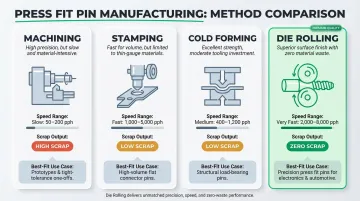
- US manufacturers use machining, stamping, cold-forming, or die rolling—each with different trade-offs in speed, cost, and consistency
- Key selection criteria: manufacturing method, defect rates, lead times, customization depth, and regulatory compliance
- Electropin leads this list with proprietary automatic die rolling technology, achieving a 1-in-600-million defect rate and fully scrap-free production
- Use this list to match your volume, tolerance, and industry requirements to the right US manufacturer
Overview of Press Fit Pins in the US Market
Press fit pins are small metal contacts—typically copper alloy with nickel or tin plating—that are mechanically pressed into plated through-holes on a PCB without solder. The connection relies on elastic deformation or interference fit to create a gas-tight, electrically reliable joint. That joint holds up under thermal cycling, vibration, and harsh environmental conditions without the failure risks associated with soldered connections.
Understanding how that reliability is achieved starts with the pin itself. Two main types dominate the market:
Pin Types and Applications
- Solid pins feature a rigid press-in zone, require higher insertion force, and demand precise drill tolerances to prevent internal PCB layer damage
- Compliant pins compress or flex during insertion, exert less stress on the board, and now dominate high-reliability applications
The global press-fit connector market reached $8.7 billion in 2022 and is projected to grow to $13.5 billion by 2032, driven by automotive electrification (which accounts for over 42% of market share), medical devices, industrial automation, and computing infrastructure.

Press fit technology is governed by strict international standards. IEC 60352-5:2020 defines general requirements and test methods for press-in connections. IPC-9797A (released in 2023) adds the industry-consensus criteria for characterizing and accepting compliant press-fit technology in automotive and high-reliability applications.
Top 10 Press Fit Pins Manufacturers in the US
These manufacturers were selected based on production technology, client industries served, quality record, US-based operations, and ability to handle custom or high-volume orders.
Electropin (Autoswage Products, Inc.)
Background: Electropin, operating as Autoswage Products, Inc., has manufactured precision contact pins since 1943. Originally founded in Connecticut to produce fluorescent lightbulb pins using cold-forming techniques, the company relocated to North Carolina and rebranded as Electropin in 2019.
Under the leadership of Keith Brenton, who brings over 35 years of experience in design-for-manufacturing optimization, Electropin serves automotive, medical, farm equipment, computer, and circuit board manufacturing industries with fully custom connector pins.
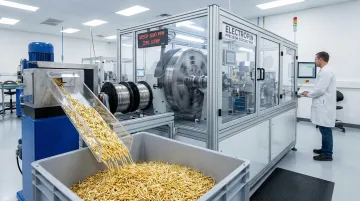
Differentiators: Electropin is the only custom contact pin manufacturer leveraging proprietary automatic die rolling technology. This cold-forming process pushes raw material into a custom die, forcing it to conform to the specified shape without cutting or heating. The result: zero scrap production, no tooling wear from part 1 to part 1,000,000, and a defect rate of just 1 in 600,000,000.
The company produces up to five pins per second, delivers first batches in as little as two weeks when raw materials are available, and offers lead-free parts without requiring leaded brass, eliminating REACH and RoHS compliance concerns at the process level.
| Manufacturing Technology | Proprietary automatic die rolling; no machining, no scrap, no tooling wear |
|---|---|
| Industries Served | Automotive, medical connectors, farm equipment, computers, circuit board and molded plastic parts manufacturing |
| Key Differentiator | Defect rate of 1 in 600,000,000; up to 5 pins/second; REACH and RoHS compliant; first batch delivery in as little as two weeks |
Mill-Max Manufacturing Corp.
Background: Founded in 1971 and headquartered in Oyster Bay, NY, Mill-Max operates a 150,000 square foot vertically integrated facility handling everything from high-speed turning to plating under one roof. The company specializes in precision-machined pins, sockets, and receptacles for high-reliability PCB applications, offering both polygon (solid) and compliant press-fit pin geometries.
Differentiators: Mill-Max's proprietary turning machines enable rapid custom designs without minimum volume constraints. The company offers extensive plating options including gold and tin over nickel, and maintains ISO 9001 certification. Their application engineering team provides detailed guidance on PCB finish compatibility—explicitly warning against Hot Air Leveling (HAL) or ENIG finishes for press-fit applications due to inhomogeneity and brittleness risks.
| Manufacturing Technology | Precision CNC machining with in-house plating capabilities |
|---|---|
| Industries Served | Aerospace, medical, defense, industrial electronics |
| Key Differentiator | Single-site US machining; extensive catalog depth; custom plating options; no minimum order quantities |
Keystone Electronics Corp.
Background: Celebrating its 75th anniversary in 2025, Keystone Electronics was founded in 1950 and recently expanded its headquarters to New Hyde Park, NY. The company offers a broad catalog of discrete press-fit PCB pins (including 1992-2 and 1994-2 series) available in gold and tin plating options, serving general electronics OEMs across diverse market segments.
Differentiators: Keystone maintains ISO 9001:2015 certification and RoHS compliance across its product range. The company's strength lies in its extensive stocked catalog, enabling rapid fulfillment for standard geometries. Press-fit hardware and PCB standoffs are available through broad distribution channels, making Keystone a preferred supplier for electronics assemblers requiring quick-turn access to standard components.
| Manufacturing Technology | Stamping and forming with multiple plating options |
|---|---|
| Industries Served | Broad electronics OEM base across consumer, industrial, and commercial sectors |
| Key Differentiator | Extensive stocked catalog; 75+ years of industry experience; wide distribution network |
Samtec, Inc.
Background: Headquartered in New Albany, IN since its founding in 1976, Samtec is a leader in high-speed and high-density interconnects. The company's SEARAY and ExaMAX product lines feature press-fit tails specifically designed for high-speed backplanes and open-pin-field arrays, supporting data rates up to 64 Gbps PAM4 for supercomputing and 5G infrastructure.
Differentiators: Samtec provides extensive engineering support through its Signal Integrity Group (SIG) lab, offering simulation, testing, and design validation services. The company holds ISO 9001 and IATF 16949 certifications across its global facilities. Their PHT/PHF press-fit socket and terminal strips are designed for automated assembly, with detailed insertion force profiles and compatible tooling specifications available for contract manufacturers.
| Manufacturing Technology | High-precision stamping and forming optimized for high-speed signal integrity |
|---|---|
| Industries Served | Data center, computing, telecommunications, military/aerospace |
| Key Differentiator | Signal Integrity Group lab support; high-speed backplane expertise; 64 Gbps PAM4 capability |
TE Connectivity (US Operations)
Background: TE Connectivity maintains multiple US manufacturing sites (Pennsylvania, Minnesota, Oregon, Massachusetts) producing automotive-grade press-fit connector pin solutions. The company's ACTION PIN, Multispring, and miniaturized NanoMultispring product families are designed for harsh automotive environments, with IEC 60352-5 testing and IATF 16949 certification.
Differentiators: TE's NanoMultispring is engineered specifically for 0.6mm PCB holes, enabling tighter pitches in engine control units (ECUs) and ADAS sensors as vehicle electronics shrink. The company provides a complete ecosystem of application tooling and servo-electric press machines, along with proprietary insertion force monitoring systems.
TE holds ISO 13485 certification for medical device manufacturing, making them a qualified supplier for both automotive and medical press-fit applications.
| Manufacturing Technology | Stamping and cold-forming with proprietary compliant pin geometries |
|---|---|
| Industries Served | Automotive, industrial automation, medical devices |
| Key Differentiator | Miniaturized compliant pins (0.4mm material thickness); complete insertion tooling ecosystem; IATF 16949 and ISO 13485 certified |
Autosplice, Inc.
Background: Founded in 1954 and based in San Diego, CA, Autosplice specializes in automation-ready interconnects for high-volume manufacturing. The company's AutoHeader products are continuously molded and supplied on reels, allowing manufacturers to cut custom pin counts on the fly and integrate press-fit assembly directly into SMT lines.
Differentiators: Autosplice manufactures its own single and dual-head pin insertion machines, making them an ideal partner for high-volume OEMs looking to automate press-fit assembly. The company holds IATF 16949 and ISO 9001 certifications, and offers 0.4mm EON press-fit terminals designed for high-speed automated insertion. Reel-to-reel formats reduce handling time and assembly defects compared to stick-fed components.
| Manufacturing Technology | Stamping with continuous reel-to-reel molding for automated assembly |
|---|---|
| Industries Served | Automotive, medical devices, telecommunications |
| Key Differentiator | In-house pin insertion systems; reel-to-reel formats; high-speed automation focus |
Interplex Industries
Background: Interplex operates US manufacturing sites in Attleboro, MA and Fort Lauderdale, FL, specializing in precision metal stamping and reel-to-reel photo etching. The company produces 0.64mm and 0.8mm press-fit terminals designed for high-speed automated insertion in automotive and medical applications.
Differentiators: Interplex's Fort Lauderdale facility holds ISO 13485 certification for medical device manufacturing, while Attleboro maintains IATF 16949 for automotive applications. The company's reel-to-reel stamping capability enables production speeds that support high-volume OEM requirements. Interplex offers solderless press-fit terminals specifically engineered for automotive power distribution and medical imaging systems.
| Manufacturing Technology | High-speed reel-to-reel stamping and photo etching |
|---|---|
| Industries Served | Automotive, medical devices, industrial electronics |
| Key Differentiator | Dual certifications (IATF 16949 and ISO 13485); reel-to-reel stamping for automation; 0.64-0.8mm terminal expertise |
Harwin (US Operations)
Background: Harwin provides high-reliability connectors through an extensive US distribution network, focusing on extreme shock and vibration applications for defense and aerospace. The company's PC/104 stackthrough connectors and Hi-Rel product families feature press-fit compatibility designed to meet MIL-spec requirements.
Differentiators: Harwin's M300 and Gecko families provide ruggedized designs for harsh environments, including spaceflight applications. The company's products are widely accessible to US buyers through major authorized distributors, ensuring rapid availability. Press-fit solutions are engineered for applications subjected to extreme mechanical stress, thermal cycling, and radiation exposure.
| Manufacturing Technology | Precision stamping and forming optimized for ruggedized applications |
|---|---|
| Industries Served | Military/aerospace, defense, industrial, spaceflight |
| Key Differentiator | MIL-spec compatible designs; extreme shock/vibration resistance; spaceflight heritage |
Würth Elektronik (US Operations)
Background: Würth Elektronik serves US customers through an established distribution network, offering REDCUBE PRESS-FIT power terminals engineered for high-current applications. The company provides detailed application guidance for press-fit components, ensuring robust mechanical and electrical connections for automotive and industrial power systems.
Differentiators: REDCUBE press-fit terminals support up to 250 A with contact resistance below 200 µOhm, making them the standard for electric vehicle inverters and battery management systems. Würth Elektronik maintains RoHS and REACH compliance across its product range and explicitly recommends immersion tin PCB finishes (avoiding HAL and ENIG) to prevent contact problems and chip formation during insertion.
| Manufacturing Technology | Stamping and forming optimized for high-current power applications |
|---|---|
| Industries Served | Automotive power systems, industrial power distribution |
| Key Differentiator | High-current capability (up to 250 A); detailed PCB finish guidance; RoHS/REACH compliance |
CW Industries (CWI)
Background: Founded in 1961 and based in Southampton, PA, CW Industries focuses heavily on insulation displacement connectors (IDC) and MIL-SPEC rectangular connectors for wire-to-board and military harness applications. The company holds ISO 9001:2015 certification and maintains Qualified Products List (QPL) status for defense applications.
Differentiators: CW Industries offers extensive PCB interconnect hardware with a strong focus on defense and industrial sectors. However, their standard public catalogs do not explicitly highlight discrete press-fit pin families, making them a better fit for wire-to-board or military harness applications rather than high-volume press-fit pin production.
| Manufacturing Technology | IDC and stamping processes focused on wire-to-board interconnects |
|---|---|
| Industries Served | Defense, industrial, consumer electronics |
| Key Differentiator | QPL status for defense applications; ISO 9001:2015 certified; strong IDC/MIL-SPEC focus |
How We Chose the Best Press Fit Pin Manufacturers
Each manufacturer on this list was rated across five criteria — the factors that actually determine whether a supplier holds up under production pressure, not just on paper:
Manufacturing Technology and Process
The production method — machining, stamping, cold-forming, or die rolling — determines cost structure, defect rates, and long-term scalability. Cold forming operates at 150–400 pieces per minute and maintains uninterrupted grain structure for greater material integrity.
Machining offers flexibility for complex geometries, but generates scrap and requires regular retooling as cutting edges dull.
Production Scalability
High-volume OEMs should prioritize suppliers offering continuously reeled press-fit formats and integrated insertion machinery to reduce cycle times. Suppliers like Autosplice and Interplex provide reel-to-reel solutions compatible with standard SMT equipment.
Defect Rates and Quality Consistency
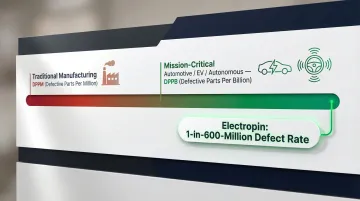
The automotive industry is shifting quality metrics from Defective Parts Per Million (DPPM) to Defective Parts Per Billion (DPPB) as autonomous and EV systems become mission-critical. Suppliers with process-level quality control — catching defects before parts are made, not after — reduce escapes that post-production inspection misses.
Regulatory Compliance
REACH and RoHS compliance requires strict documentation. IPC-1752B (updated in 2025) outlines material declaration requirements, and exemption 8(f)(b) specifically covers "Lead in compliant pin connector systems" for automotive applications. Verify that any supplier you shortlist provides current IPC-1752B XML declarations — not just a checkbox on a data sheet.
Custom Capability and Total Cost of Ownership
Custom capability covers how well a supplier handles non-standard geometries, tolerances, and material specs — and how quickly they can deliver a first production run. Lead times vary widely: some suppliers quote 8–12 weeks for custom tooling; others, like Electropin, can deliver an initial batch in two weeks.
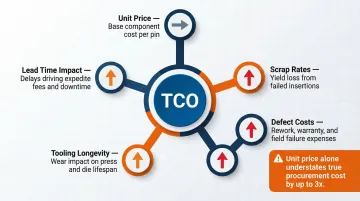
The most common procurement mistake is choosing on unit price alone. Scrap rates, defect costs, and tooling longevity all affect what you actually pay. Manufacturers that solve quality at the process level consistently deliver lower total cost of ownership than those relying on post-production sorting.
Conclusion
The right press fit pin manufacturer for your application comes down to three things: production technology, quality controls, and scalability at your required volumes. Size and name recognition rarely determine which supplier actually performs.
When comparing suppliers, evaluate total cost of ownership — not unit price alone. Defect rates, scrap output, lead times, and production scalability all affect what you actually pay per good part. A manufacturer with a 1-in-600-million defect rate and zero scrap production will deliver better long-term value than a lower-priced supplier with 500 DPPM and 20% material waste.
If your application demands the highest quality-to-cost ratio in custom contact pins, Electropin's proprietary automatic die rolling technology produces up to five pins per second with a defect rate of 1 in 600,000,000 — and zero scrap. Contact the Electropin team to walk through your specifications and get a quote.
Frequently Asked Questions
What is a press fit pin and how does it work?
A press fit pin is a metal contact mechanically pressed into a plated through-hole on a PCB without solder. The pin's geometry creates an interference or compliant fit that ensures a gas-tight, electrically reliable connection capable of withstanding thermal cycling and vibration.
What are the differences between solid and compliant press fit pins?
Solid pins do not deform on insertion and require high insertion force, risking PCB damage if drill tolerances aren't precise. Compliant pins compress or flex during insertion, exerting less stress on the board and producing more reliable results in automotive, industrial, and high-vibration applications.
What industries use press fit pins most?
Primary US industries include automotive (ECUs, infotainment, EV drivetrains), medical connectors, industrial automation, computing infrastructure, and farm equipment. Automotive accounts for over 42% of global press-fit connector market share due to electrification and ADAS proliferation.
What are pins generally manufactured from?
Press fit pins are typically made from copper alloys (brass or phosphor bronze) for conductivity and formability, with surface finishes of nickel plating and tin or gold for corrosion resistance. Some manufacturers offer lead-free options compliant with REACH and RoHS.
Can you make enamel pins in the USA?
Enamel pins (decorative badges) are distinct from electrical press fit pins. Most enamel pin production has moved offshore, though some US-based specialty manufacturers offer domestic production for small-batch or branded applications.
How do I choose the right press fit pin manufacturer in the US?
Start by defining your volume requirements and tolerance specs, then evaluate manufacturers on:
- Manufacturing process — machining, die rolling, or stamping each have different cost and precision tradeoffs
- Defect rates — ask for documented quality metrics, not just claims
- Lead times — especially for custom orders and first-article runs
- Certifications — REACH, RoHS, and ISO compliance matter for regulated industries
- Industry experience — a manufacturer familiar with automotive or medical applications will flag design issues early