Introduction
Procurement engineers and OEMs face mounting pressure when sourcing custom contact pins at scale. Teams must simultaneously balance cost targets, quality requirements, lead time constraints, and near-zero defect tolerances—all while serving automotive, medical, and industrial electronics sectors where component failure carries serious consequences.
Bead Electronics is a well-established supplier of custom contact pins, known for its cold-forming process. Engineering teams search for alternatives due to pricing constraints, delivery timelines that don't align with production schedules, or the need for processes better suited to high-volume, zero-defect environments where scrap rates and regulatory compliance are non-negotiable.
TLDR
- Bead Electronics makes custom hollow and solid wire contact pins via scrapless swaging for automotive, medical, and industrial use
- Teams seek alternatives due to cost structures, lead times, scrap concerns, compliance requirements, and scalability limits
- Top 5 alternatives: Electropin, Mill-Max Manufacturing Corp., Interplex Industries, Smiths Interconnect, and Harwin
- Electropin's automatic die rolling technology delivers 1 in 600,000,000 defect rate with lead-free production and no REACH/RoHS concerns
- Evaluate suppliers on manufacturing method, documented defect rates, delivery speed, compliance posture, and proven scalability
What Is Bead Electronics?
Bead Electronics is a Connecticut-based manufacturer specializing in custom solid wire pins, hollow pins, and pin assemblies produced through a scrapless swaging (cold-forming) process. The company serves automotive, aerospace, medical, industrial, and lighting sectors, holding ISO 9001:2015 and IATF 16949:2016 certifications.
Buyers typically search for alternatives when one or more of these issues surfaces:
- Extended lead times that delay production schedules
- Tooling investment costs that don't align with order volume
- Minimum order quantities that exceed prototype or low-volume needs
- Regulatory uncertainty around EU RoHS Annex III Exemption 6(c) for leaded brass, which expires December 31, 2026
Each alternative in this list is evaluated on:
- Manufacturing capability and its effect on defect rates
- Quality consistency across production runs
- Delivery speed from prototype to volume
- REACH/RoHS/lead-free compliance readiness
- Proven performance across relevant industries
Top 5 Bead Electronics Alternatives for Custom Contact Pins
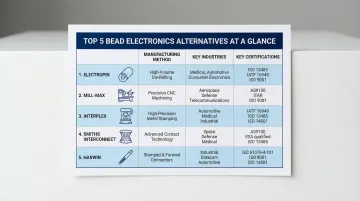
These alternatives were selected based on manufacturing technology differentiation, documented defect control, industry certifications, established client base, and ability to serve high-mix, high-volume production environments.
Electropin
Electropin is a North Carolina-based custom contact pin manufacturer with over 80 years of manufacturing innovation history, founded in 1943 as Autoswage Products, Inc. The company serves automotive, medical, farm equipment, computing, and circuit board manufacturing sectors using a proprietary automatic die rolling process that fundamentally differs from traditional manufacturing methods.
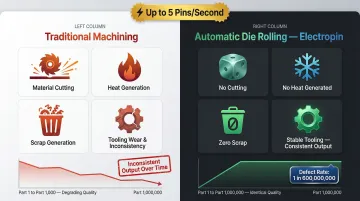
The core differentiator: unlike machined pin manufacturing (used by most competitors, including Bead Electronics), Electropin's automatic die rolling process requires no cutting or heating. Tools don't dull, there is no scrap, and the process produces up to 5 custom connector pins per second with a documented defect rate of 1 in 600,000,000. First-batch delivery can be as fast as two weeks when raw materials are available.
| Attribute | Specification |
|---|---|
| Manufacturing Method | Automatic die rolling (no cutting, no heating, no scrap) |
| Defect Rate | 1 in 600,000,000 — consistent from part 1 to part 1 million |
| Compliance | Lead-free pins produced without leaded brass; no REACH or RoHS concerns |
Mill-Max Manufacturing Corp.
Mill-Max is a New York-based precision connector manufacturer with a long track record in producing machined pins, receptacles, and interconnects for medical, aerospace, defense, and industrial applications. The company operates from a single, vertically integrated US manufacturing facility in Oyster Bay, New York.
Key differentiators include an extensive catalog of standard pin configurations with customization options, strong traceability documentation, and established aerospace/medical certifications. Mill-Max offers a low minimum order quantity of 1,000 pieces for custom discrete components, with typical lead times ranging from 3 to 12 weeks depending on complexity. Prototypes can be delivered in as little as 2 weeks. Their quality management system meets ISO 9001:2015 standards.
| Attribute | Specification |
|---|---|
| Manufacturing Method | CNC precision machining (high-speed turning/screw machining) |
| Key Industries | Medical, aerospace, defense, industrial electronics, test equipment |
| Certifications | ISO 9001:2015-based quality system; standard tolerances of ±0.002" |
Interplex Industries
Interplex is a Singapore-headquartered global precision metal components manufacturer specializing in progressive stamping, fine blanking, and insert molding. The company serves automotive, medical, and consumer electronics OEMs with complex connector assemblies and contact components across a substantial global footprint.
Their differentiators include 33 manufacturing sites across 13 countries with approximately 13,000 employees, strong automotive-sector relationships, and the ability to integrate pins into multi-component assemblies. Interplex holds IATF 16949 certification at 25 sites and ISO 13485 (medical) certification at 7 sites, qualifying them for regulated-industry supply chains. Their high-speed stamping processes are optimized for mass production where tooling costs can be amortized over millions of parts.
| Attribute | Specification |
|---|---|
| Manufacturing Method | Progressive stamping, fine blanking, insert molding, cold forging |
| Key Industries | Automotive/e-mobility, medical, consumer electronics, data communications |
| Global Presence | 33 manufacturing sites across 13 countries; 13,000 employees |
Smiths Interconnect
Smiths Interconnect is a UK-headquartered global provider of technically differentiated electronic components and subsystems, including precision contact pins and connectors for defense, aerospace, medical, and semiconductor test markets. As of March 2026, the company is in a transitional ownership phase, with its acquisition by Molex (a Koch Industries subsidiary) expected to close in H1 2026.
Their differentiators include deep specialization in high-reliability and harsh-environment connector systems, along with defense-grade qualification. Their differentiators include deep specialization in high-reliability and harsh-environment connector systems, along with defense-grade qualification. Proprietary contact technologies include Hypertac® hyperboloid contacts (rated for up to 100,000 mating cycles) and HyperSpring® contacts for high-density applications. The company holds AS9100D and ISO 9001:2015 certifications, with products designed to meet or exceed numerous MIL-specs including MIL-DTL-55302, MIL-DTL-38999, and MIL-DTL-83723.
| Attribute | Specification |
|---|---|
| Manufacturing Method | Precision machining, advanced materials processing, hyperboloid contact technology |
| Key Markets | Defense, aerospace, medical, semiconductor test, space |
| Differentiator | MIL-spec qualification; Hypertac® contacts rated for 100,000 mating cycles |
Harwin
Harwin is a UK-based connector and contact pin manufacturer with global distribution, known for high-reliability connectors used in aerospace, defense, industrial, and transportation applications. Their Gecko (G125) and Datamate (M80) series are field-proven in extreme environments.
Key differentiators include a catalog-driven product range with custom options, focus on high-vibration and harsh-environment connector reliability (rated for 20G vibration and 100G shock), and established global distribution through Digi-Key, Mouser Electronics, and RS Components. Harwin holds ISO 9001:2015 and EN 9100:2018 (AS9100) certifications. Their patented 4-finger Beryllium Copper contacts in the Gecko series are rated for 1,000 mating cycles and operate across -65°C to +150°C.
| Attribute | Specification |
|---|---|
| Manufacturing Method | Precision stamping and machining; 4-finger Beryllium Copper contact technology |
| Key Industries | Aerospace, defense, industrial, transportation, UAVs, motorsport |
| Distribution | Global network via Digi-Key, Mouser Electronics, RS Components |
How We Chose These Alternatives
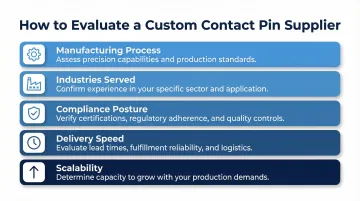
Each alternative was evaluated against criteria that directly affect long-run production outcomes:
- Manufacturing process — how it affects defect rate, part-to-part consistency, and scrap generation
- Industries served — proven performance in your target sector
- Compliance posture — REACH/RoHS readiness and lead-free capability
- Delivery speed — from prototype through high-volume production
- Scalability — documented capacity for both initial runs and million-part orders
Critical mistake to avoid: Choosing a supplier based on catalog size or brand recognition alone without evaluating how the underlying manufacturing method affects long-run consistency, total cost of ownership, and defect exposure at volume. Cold-forming and rolling processes maintain dimensional stability across millions of parts because tools don't degrade — a machined pin process, by contrast, generates scrap and loses consistency as tooling dulls.
Compliance readiness is non-negotiable. With the EU RoHS exemption for leaded brass expiring December 31, 2026, teams that overlook compliance during supplier selection risk costly mid-program supplier switches.
A supplier change driven by regulatory non-conformance triggers full PPAP re-qualification cycles and major schedule risk — a particularly serious exposure in automotive and medical programs where component reliability is paramount.
Conclusion
Bead Electronics serves a clear market with its scrapless swaging process, but engineering teams with exacting quality, compliance, or cost requirements benefit from evaluating purpose-built alternatives whose manufacturing processes directly address scrap, defect rates, and lead time constraints.
Go beyond brochure comparisons. When vetting suppliers, ask for:
- Documented defect rates with statistical validation
- First-article lead times for your specific volume
- Compliance certifications (not just claims)
- Evidence of consistency at your target production volume
- Customer references from your industry and application environment
Electropin's automatic die rolling process—the only one used in custom contact pin manufacturing—delivers a defect rate of 1 in 600,000,000, lead-free compliance, and first batches in as little as two weeks. Reach the Electropin team at +1 919-288-1203 to discuss your application.
Frequently Asked Questions
What is the alternative to gold in electronics?
Common gold alternatives in electronic contacts include tin, silver, palladium-nickel alloys, and selective plating combinations. Material choice depends on the application's conductivity requirements, environmental exposure, expected mating cycles, and cost targets. Palladium-nickel with gold flash offers noble metal performance at lower cost, while tin provides excellent solderability for solder tails and press-fit terminations.
Is a ferrite bead necessary?
Ferrite beads are not universally required—they are used selectively for high-frequency noise suppression on power lines and signal traces. Whether one is needed depends on EMI testing results, circuit operating frequency, and the specific PCB layout. Many designs operate successfully without ferrite beads when EMI levels fall within acceptable limits.
What is the difference between a ferrite bead and an inductor?
While both are inductive components, a ferrite bead is designed to dissipate high-frequency noise as heat, acting as a bandstop filter for EMI suppression. An inductor stores and releases energy and is used in filtering, tuning, or energy conversion circuits. Ferrite beads have high resistance at target frequencies; inductors have low DC resistance and are characterized by their inductance value.
What is another name for a ferrite bead?
Ferrite beads are also called ferrite chokes, EMI suppression beads, or ferrite cores, depending on the package type (SMD chip bead vs. toroidal core) and the specific filtering application.
What should I look for when choosing a Bead Electronics alternative for custom contact pins?
Prioritize manufacturing method, lead time flexibility, and verified regulatory compliance (REACH, RoHS). Ask for documented defect rates, PPAP documentation, and customer references at your target production volume — certifications matter more than claims.
How does Electropin differ from other custom contact pin manufacturers?
Electropin uses automatic die rolling, a scrap-free cold-forming process that produces pins at up to 5 per second with a defect rate of 1 in 600,000,000. Tools never dull, so consistency holds from part 1 to part 1 million. First batches can ship in as little as two weeks, and all pins are lead-free, removing REACH and RoHS compliance concerns entirely.