Introduction
You have a Deutsch connector in hand, but which pins do you need? Choose the wrong pin size and you'll end up with a failed crimp, unreliable connection, or wasted materials. Deutsch pins—the metal contacts inside the connector housing—are where most selection mistakes happen. Pick the wrong type, and the housing itself becomes irrelevant.
Deutsch pins — also called contacts or terminals — are the current-carrying components inside Deutsch connectors. Selecting the right one requires understanding pin size, connector series, pin type, and plating.
This guide covers all five Deutsch pin sizes, the major connector series (DT, DTM, DTP, DTHD, DRC), solid versus stamped & formed construction, nickel versus gold plating, and a step-by-step selection process.
Key Takeaways
- Deutsch pins are the metal contacts inside connector housings—pick the wrong one and you get an unreliable connection
- Five standard pin sizes exist: 4, 8, 12, 16, and 20—each designed for specific amperage ranges and wire gauges
- Each Deutsch series (DTM, DT, DTP, DTHD, DRC) is paired with specific pin sizes matched to its current demands
- Pins come in solid or stamped & formed styles and nickel or gold plating—your circuit type determines which combination is right
- Start with circuit amperage, match wire gauge second, then select style and plating for the application
What Are Deutsch Pins and How Do They Work?
Deutsch pins are the current-carrying metal contact elements seated inside Deutsch connector housings. They are distinct from the housing, wedgelocks, and wire seals, which are structural components only. The pin is what actually transfers electrical current from one circuit to another.
Anatomy of a Deutsch Pin
Each Deutsch pin consists of three critical zones. The wire-entry barrel is where the conductor is crimped, creating the electrical and mechanical connection. The retention feature locks inside the housing cavity, preventing the pin from backing out under vibration. The mating contact interface—either a male pin or female socket—transfers electrical current when the connector halves mate.
Pins are manufactured from copper alloy and then plated with nickel or gold to resist oxidation and corrosion. Once crimped, pins are inserted into numbered cavities and held by integrated retention springs. A wedgelock is then inserted over the pins to lock them in place and prevent backout under vibration, shock, or thermal cycling.
How Pins Are Retained in the Housing
Deutsch connectors use a robust two-level retention system. The primary retention mechanism consists of flexible locking fingers integral to the housing's plastic cavity. When a contact is inserted from the rear, these fingers deflect and snap back into place behind the contact's retention shoulder, producing an audible click. A light tug on the wire confirms proper seating.
After all contacts are inserted, a secondary locking device—a wedgelock or Terminal Position Assurance (TPA) device—is installed at the front of the connector. This wedgelock confirms all contacts are fully seated and provides a secondary locking force that prevents the primary locking fingers from releasing the contacts, even in extreme vibration environments.
How Contact Pins Are Manufactured
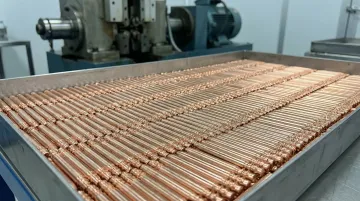
Retention performance depends heavily on how precisely a pin is made — which comes down to the manufacturing method. Two approaches exist: traditional machining, which cuts or drills from metal stock and generates scrap while introducing dimensional inconsistencies, and cold-forming techniques like automatic die rolling, which shape metal without cutting. Automatic die rolling produces more dimensionally consistent pins at lower material cost because the tools don't dull or change shape with heat.
Electropin, a custom contact pin manufacturer with over 80 years in the industry, uses automatic die rolling to achieve a defect rate of 1 in 600,000,000. That level of consistency matters in high-volume production for automotive, medical, and farm equipment applications where a single bad contact can cause a system failure. The process also eliminates scrap entirely: when you pay for five pounds of material, you get five pounds of pins.
Deutsch Pin Sizes: A Complete Breakdown
Deutsch pin sizes are numbered inversely to their physical size—a Size 4 pin is the largest and handles the most current, while a Size 20 is the smallest and carries the least. There are five standard sizes: 4, 8, 12, 16, and 20. Each size is designed for a specific amperage range and wire gauge.
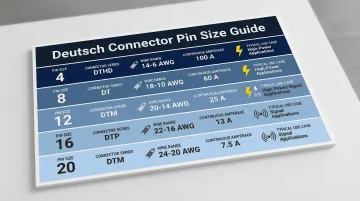
Here's how all five sizes compare at a glance:
| Size | Series | Wire Range (AWG) | Wire Range (mm²) | Continuous Amps (125°C) | Typical Use |
|---|---|---|---|---|---|
| 20 | DTM | 16–22 AWG | 0.35–1.5 mm² | 7.5 A | Sensors, signal wiring, data circuits |
| 16 | DT | 14–20 AWG | 0.50–2.50 mm² | 13 A | Solenoids, lighting, general controls |
| 12 | DTP | 10–14 AWG | 2.0–6.0 mm² | 25 A | Fuel pumps, fans, motors, heaters |
| 8 | DTHD | 8–10 AWG | 5.0–10.0 mm² | 60 A | Heavy equipment power feeds |
| 4 | DTHD | 4–6 AWG | 13.0–25.0 mm² | 100 A | Main power feeds, mining and marine |
Size 20 – DTM Series
Size 20 is the smallest Deutsch contact. It's the go-to choice for sensors, low-power signal wiring, and data circuits where environmental sealing matters more than current capacity.
Size 16 – DT Series
Size 16 is the most widely used Deutsch contact across automotive, agricultural, and industrial applications. Its broad AWG range makes it flexible enough for solenoids, lighting, and general control wiring without stepping up to a larger connector.
Size 12 – DTP Series
Size 12 steps up to high-current loads—fuel pumps, fans, motors, and heaters—where you need a sealed, multi-pin power connection in a compact footprint.
Size 8 and Size 4 – DTHD Series
Both sizes are exclusive to the DTHD (Heavy Duty) series and are single-wire connectors. Use Size 8 for heavy equipment power feeds; reach for Size 4 when you're wiring main power runs in mining, marine, or heavy construction equipment where 100 amps continuous is the requirement.
Types of Deutsch Connectors and Their Pin Requirements
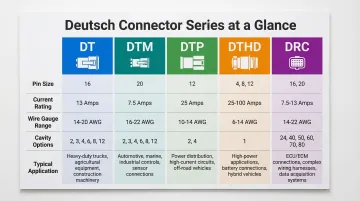
Deutsch connector series are defined largely by their pin size and current rating. Selecting a series and selecting a pin size are effectively the same decision. The table below summarizes key specifications across all five major series:
| Series | Pin Size | Current Rating | Wire Gauge Range | Cavity Options | Typical Applications |
|---|---|---|---|---|---|
| DT | 16 | 13 A | 14–20 AWG (2.50–0.50 mm²) | 2, 3, 4, 6, 8, 12 (in-line, flange, PCB) | Truck, bus, agriculture, marine, general harsh-environment wiring |
| DTM | 20 | 7.5 A | 16–22 AWG (1.0–0.35 mm²) | 2, 3, 4, 6, 8, 12 (in-line, flange, PCB) | ECU/sensor wiring, lighting control, low-current signal circuits |
| DTP | 12 | 25 A | 10–14 AWG (6.00–2.00 mm²) | 2, 4 (in-line, flange, PCB) | Fuel pumps, winches, fans, high-amperage accessories |
| DTHD | 4, 8, 12 | 100 A, 60 A, 25 A | 4–14 AWG (25.0–2.0 mm²) | 1 (single-cavity) | Mining, construction, heavy marine, isolated high-current circuits |
| DRC | 16, 20 | 13 A, 7.5 A | 14–22 AWG (2.50–0.35 mm²) | 24–80 (high-density rectangular) | Engine control units, transmissions, robotics, complex wiring harnesses |
The specs above cover the basics. The breakdowns below explain what actually differentiates each series at the selection stage.
DT Series – Most Common Across General Wiring
For most truck, agricultural, and marine wiring projects, the DT series is the default starting point. Size 16 contacts handle 13 amps continuous — enough for the majority of vehicle and equipment circuits — and the 12 available cavity counts (2 through 12 in-line, plus flange mount up to 48) mean one series covers a wide range of harness configurations.
The DT series supports IP67, IP68, and IP6K9K sealing with the appropriate backshell, giving engineers flexibility to specify the right protection level without switching connector families.
DTM Series – Compact Footprint for Signal Circuits
When circuit density matters and current draw is low, the DTM series is the right choice. The "M" stands for Miniature — Size 20 contacts, rated 7.5 amps, in the same 2–12 cavity range as the DT but in a smaller shell.
DTM connectors are the standard choice for ECU and sensor wiring, lighting control modules, and any signal circuit where space is constrained. IP68 and IP6K9K ratings make them viable in the same outdoor and submersion environments as larger Deutsch series.
DTP Series – Dedicated High-Current Runs
The DTP series trades circuit count for current capacity. Size 12 contacts rated at 25 amps continuous are designed for single-purpose power runs — fuel pumps, winches, fans, and similar high-draw accessories — which is why the series only offers 2 and 4 cavity options. This isn't a limitation so much as a design intent: DTP connectors aren't built for multi-circuit looms.
Silicone rear wire seals and interfacial seals deliver IP68 immersion protection, making DTP a reliable choice for underbody and bilge installations.
DTHD Series – Isolated High-Current Circuits
The DTHD series takes a different approach: one conductor per connector. Each single-cavity connector uses Size 4, 8, or 12 contacts rated from 25 to 100 amps, designed specifically for applications where individual high-current circuits must stay isolated from one another.
DTHD connectors are the standard choice in mining, construction, and heavy marine applications. They're IP68-rated and field-serviceable — a practical replacement for splices in environments where maintenance access is limited and connection integrity is non-negotiable.
DRC Series – High Pin Count in a Compact Shell
The DRC series addresses the opposite problem from DTHD: when an application needs 24 to 80 circuits in a single connector. Size 16 and Size 20 contacts (and select Size 12 configurations) are arranged in high-density rectangular housings, making DRC the right fit for engine control units, transmission harnesses, and robotics applications.
Jackscrew locking — rather than a lever or latch — keeps mated connectors secure under the vibration and thermal cycling typical in these environments.
Solid vs. Stamped & Formed Pins: Which Type Should You Use?
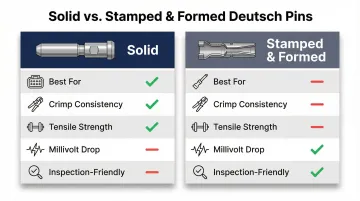
Stamped & formed pins are punched from flat metal sheet and bent into shape. They are the more economical option and work well for most standard wiring applications.
Solid pins are machined or cold-formed from round metal stock. Their true cylindrical barrel makes them easier to crimp consistently across a broader range of wire sizes and allows soldering, though Deutsch recommends crimping over soldering for reliable connections.
When to Use Each Type
| Stamped & Formed | Solid | |
|---|---|---|
| Best for | Cost-sensitive, high-volume standard applications | Critical circuits: aerospace, medical, precision industrial controls |
| Crimp consistency | Adequate for standard wire sizes | Superior across a broader range of wire sizes |
| Crimp tensile strength | Standard | Higher |
| Millivolt drop | Standard | Lower — more stable power delivery |
| Inspection-friendly | Limited | Yes |
Crimp Tool Compatibility
Each pin type requires attention to crimp tool compatibility. Solid contacts accept a broader range of crimp tool dies, while stamped & formed contacts often require a specific formed-style crimper. For example, Size 16 stamped contacts require DTT-16-00 or DTT-16-01 hand tools, while solid Size 16 contacts use HDT-48-00 or HDT-1561 hand tools. Using the wrong tool voids the connection's reliability regardless of pin quality.
Nickel vs. Gold Plating for Deutsch Pins
Nickel plating is the standard finish, providing good corrosion resistance and durability for power, lighting, and control circuits. Gold plating adds a thin layer over the nickel, sharply reducing contact resistance at very low voltages—critical for sensor signals, data lines, and communication circuits where voltage drops of even a few millivolts affect accuracy.
Decision Rule for Plating Selection
The choice comes down to circuit type:
- Nickel: Power wiring, control wiring, lighting circuits
- Gold: Sensor signals, analog data, CAN bus, communication lines
- Gold (required): Any "dry circuit" operating below 5V and 50mA
Gold's resistance to oxidation maintains a stable, low-resistance connection — exactly what low-energy circuits need to preserve signal integrity.
Mixing plating types in the same connector is not recommended. TE Connectivity explicitly prohibits mating gold-coated contacts to tin-coated contacts due to galvanic corrosion risk — when dissimilar metals contact each other in the presence of moisture, the less noble metal (tin) corrodes at an accelerated rate.
If a connector housing carries both signal and power pins, evaluate the dominant circuit type and standardize on a single plating material throughout.
Durability and Mating Cycles
Plating material also determines how many times a connector can be disconnected and reconnected before contact reliability degrades:
| Plating Material | Rated Mating Cycles |
|---|---|
| Tin | Up to 10 |
| Silver | Up to 50 |
| Gold | Up to 100 |
For applications that see frequent disconnection — diagnostic ports, service connectors, modular equipment — gold's durability advantage is substantial.
How to Select, Crimp, and Source Deutsch Pins
Step-by-Step Pin Selection
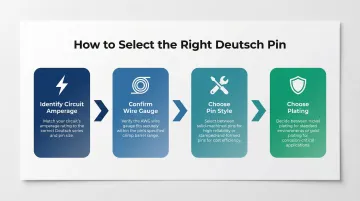
Follow this four-step selection logic:
- Identify circuit amperage requirement to determine connector series and pin size
- Confirm wire gauge falls within the pin's rated range
- Choose solid or stamped & formed based on application and tooling
- Choose nickel or gold plating based on circuit type
If a design requires passing more current than a single pin's rating, the load can be split across two pins using parallel wiring within the same connector.
Crimping and Installation
Each Deutsch pin size requires a dedicated crimp tool with its own specified die. Using the wrong tool produces an unreliable crimp even when the result looks correct visually.
Common Crimp Tools by Contact Type:
Solid Contacts:
- HDT-48-00, HDT-1561, or HDT-50-00 hand tools for Sizes 12, 16, 20
- HDT-04-08 hand tool for Sizes 4 and 8
- HDP-400 (TE PN 1606312-1) pneumatic bench tool for all sizes
Stamped & Formed Contacts:
- DTT-20-00 / DTT-20-02 hand tools for Size 20
- DTT-16-00 / DTT-16-01 hand tools for Size 16
- DTT-12-00 / DTT-12-01 hand tools for Size 12
After crimping, pins are inserted into the connector cavity until the retention spring engages. A wedgelock is then pressed over the inserted pins to prevent backout.
Pin removal requires a purpose-built extraction tool — never an improvised substitute. Common options include:
- DT-RT1 — multi-use removal tool compatible with multiple sizes
- 0411-240-2005 — Size 20 (red)
- 0411-310-1605 — Size 16 (light blue)
- 0411-337-1205 — Size 12 (orange)
When Custom Pins Are the Right Answer
Standard catalog Deutsch pins cover most applications. But high-volume OEM production, custom wire gauges, or non-standard connector designs often call for custom-manufactured contact pins instead.
Manufacturers like Electropin produce custom contact pins via automatic die rolling for automotive, medical, farm equipment, and industrial applications. This process delivers lead-free, REACH/RoHS-compliant pins with first-batch delivery in as little as two weeks — often at lower cost than machined alternatives. The technology runs at up to five pins per second with a defect rate of 1 in 600,000,000, and eliminates material waste entirely, making it a practical choice for mid-to-high volume OEM programs.
Frequently Asked Questions
What are the different size Deutsch pins?
There are five standard Deutsch pin sizes: Size 4 (100 A), Size 8 (60 A), Size 12 (25 A), Size 16 (13 A), and Size 20 (7.5 A). The numbering is inverse to physical size—Size 4 is the largest, Size 20 is the smallest.
What are the different types of Deutsch connectors?
The five main Deutsch connector series are DTM (miniature/sensor, 7.5 A), DT (general-purpose, 13 A), DTP (power, 25 A), DTHD (heavy-duty, 25–100 A), and DRC (high-density, 7.5–13 A).
What is the difference between solid and stamped and formed Deutsch pins?
Solid pins are machined or cold-formed for consistent barrel dimensions and broader crimp tool compatibility. Stamped & formed pins are punched from flat sheet metal, making them more economical and suitable for standard wiring applications.
Should I use nickel or gold plated Deutsch pins?
Nickel plating is standard for power and lighting circuits. Gold plating is recommended for critical low-voltage circuits such as sensors, data, and CAN bus communications where minimizing contact resistance is essential.
Can Deutsch pins be soldered instead of crimped?
Solid Deutsch pins can technically be soldered, but TE Connectivity does not recommend it. Crimping is the preferred method because it creates a cold-weld gas-tight connection that outperforms solder in vibration-prone environments.
How do I remove a Deutsch pin from a connector?
Remove the wedgelock first using a removal pick or extraction tool. Then insert a purpose-built Deutsch terminal extraction tool alongside the pin to release the retention spring, allowing the pin to slide out without damaging the housing.